
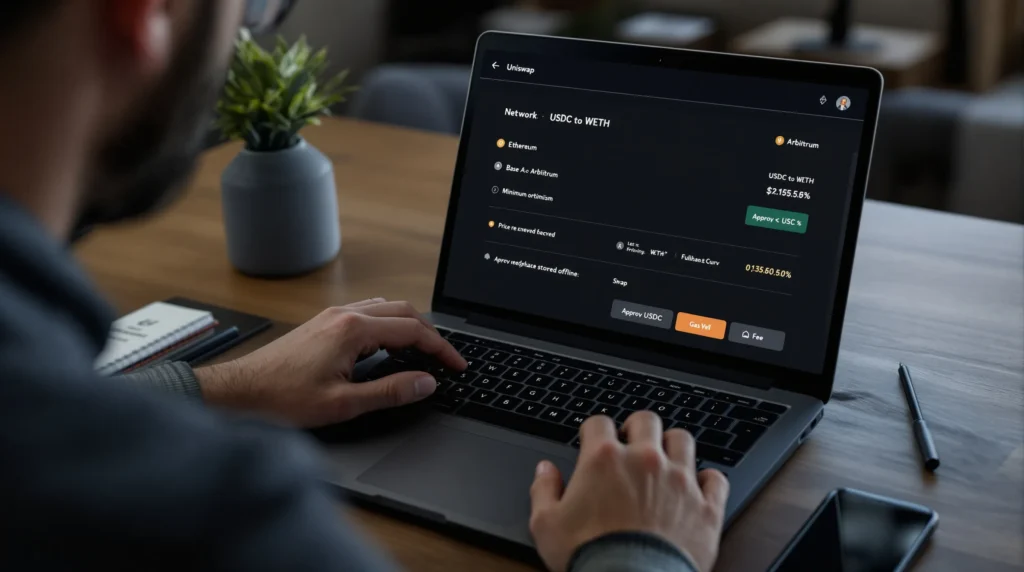
New to Uniswap and curious how a wallet-based swap actually works? In about 10 minutes, you’ll learn how to connect a wallet, pick the right network, set slippage, approve tokens safely, and confirm your first trade, without getting tripped up by gas fees or fake tokens.
This guide is built for U.S. investors who want a clean, reliable checklist to execute their first on-chain swap and understand the risks. By the end, you’ll have the confidence to navigate Uniswap on Ethereum or a lower-cost Layer-2, plus tips to keep costs down and stay secure.
Know What You’re Using: How Uniswap Works And The Risks

Understand AMMs, Pools, And Routing (Why Prices Move)
Why it matters: You’ll make better swaps when you know how prices form and why they shift mid-transaction.
- Automated Market Maker (AMM): Instead of order books, Uniswap uses math to price trades from liquidity pools. Prices adjust automatically based on pool balances.
- Liquidity Pools (LPs): Token pairs (e.g., ETH/USDC) funded by liquidity providers (LPs). Deep pools = tighter spreads and less price impact.
- Routing: Uniswap routes through one or multiple pools to get the best rate. You might swap USDC → WETH → TOKEN for optimal pricing.
- Slippage: The difference between the quoted price and the executed price due to pool movements and latency.
Simple glossary:
- AMM: Algorithmic pricing using pooled liquidity: no traditional order book.
- Slippage: The percent price change between the quote and the final fill.
- LP (Liquidity Provider): A user who deposits tokens into a pool to earn fees.
Know What You Sign: Swaps, Approvals, And Gas Fees
Why it matters: Every click is an on-chain action with cost and risk.
- Approval: One-time permission for a token (like USDC) so Uniswap can spend it on your behalf. You can limit the allowance.
- Swap: The actual token exchange. You pay gas for each on-chain action (approval + swap on Ethereum: sometimes batched on L2s).
- Gas: Network fee paid in the chain’s native token (ETH on Ethereum/Base/Arbitrum/Optimism). Fees vary with congestion.
Tip: Prefer “custom spend limit” approvals to reduce exposure if a dApp is compromised.
Risk Snapshot: Volatility, Smart-Contract Risk, And Scams
Why it matters: On-chain markets are powerful but unforgiving.
- Market/Volatility risk: Token prices can move fast: slippage settings and liquidity depth matter.
- Smart-contract risk: Bugs or vulnerabilities can impact funds. Stick to battle-tested protocols and official interfaces.
- Scam tokens: Fake contract addresses can mimic real tickers. Always verify contract addresses from trusted sources.
- MEV/front‑running: Bots can sandwich transactions. You can mitigate with tighter slippage or private RPCs.
Rule of thumb: If you can’t verify a token’s contract or can’t afford the fees, don’t click “Confirm.”
Set Up And Secure Your Crypto Wallet
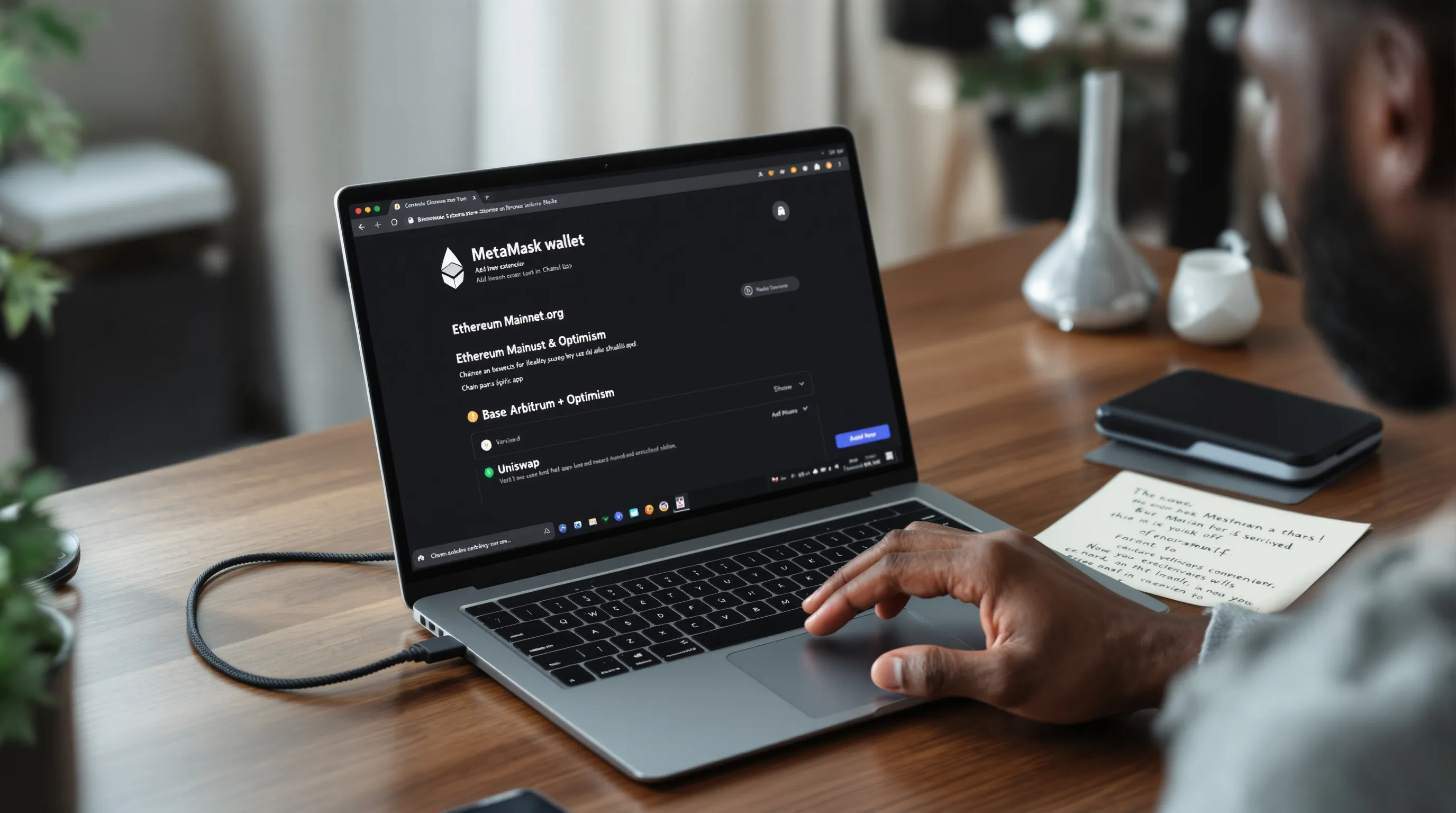
Install A Trusted Wallet (MetaMask, Coinbase Wallet)
Why it matters: Your wallet is your account, bank, and exchange interface.
- Choose a reputable wallet: MetaMask and Coinbase Wallet are widely used and well-documented.
- Install the browser extension or mobile app from the official site/app store only. Beware of lookalikes.
- Create a new wallet and set a strong password for local access.
Add Networks You’ll Use (Ethereum, Base, Arbitrum, Optimism)
Why it matters: Fees and liquidity differ by network.
- Default networks: MetaMask ships with Ethereum Mainnet. Add L2s (Base, Arbitrum, Optimism) via official sites or chainlist.org.
- Confirm chain IDs and RPC URLs match official docs before adding.
- Expect: Ethereum = highest liquidity, higher fees: L2s = lower fees, growing liquidity.
Lock Down Security (Seed Phrase, Hardware Wallet, Passkeys)
Why it matters: Recovery and transaction safety are everything.
- Seed phrase: Write it on paper and store offline in two locations. Never screenshot or share.
- Hardware wallet: Consider Ledger or Trezor for large balances. Connect via your software wallet for signing.
- Extra protections: Enable phishing warnings, use a dedicated browser profile, and consider passkeys/2FA for any linked services (exchanges, email).
Fund Your Wallet And Pick The Right Network
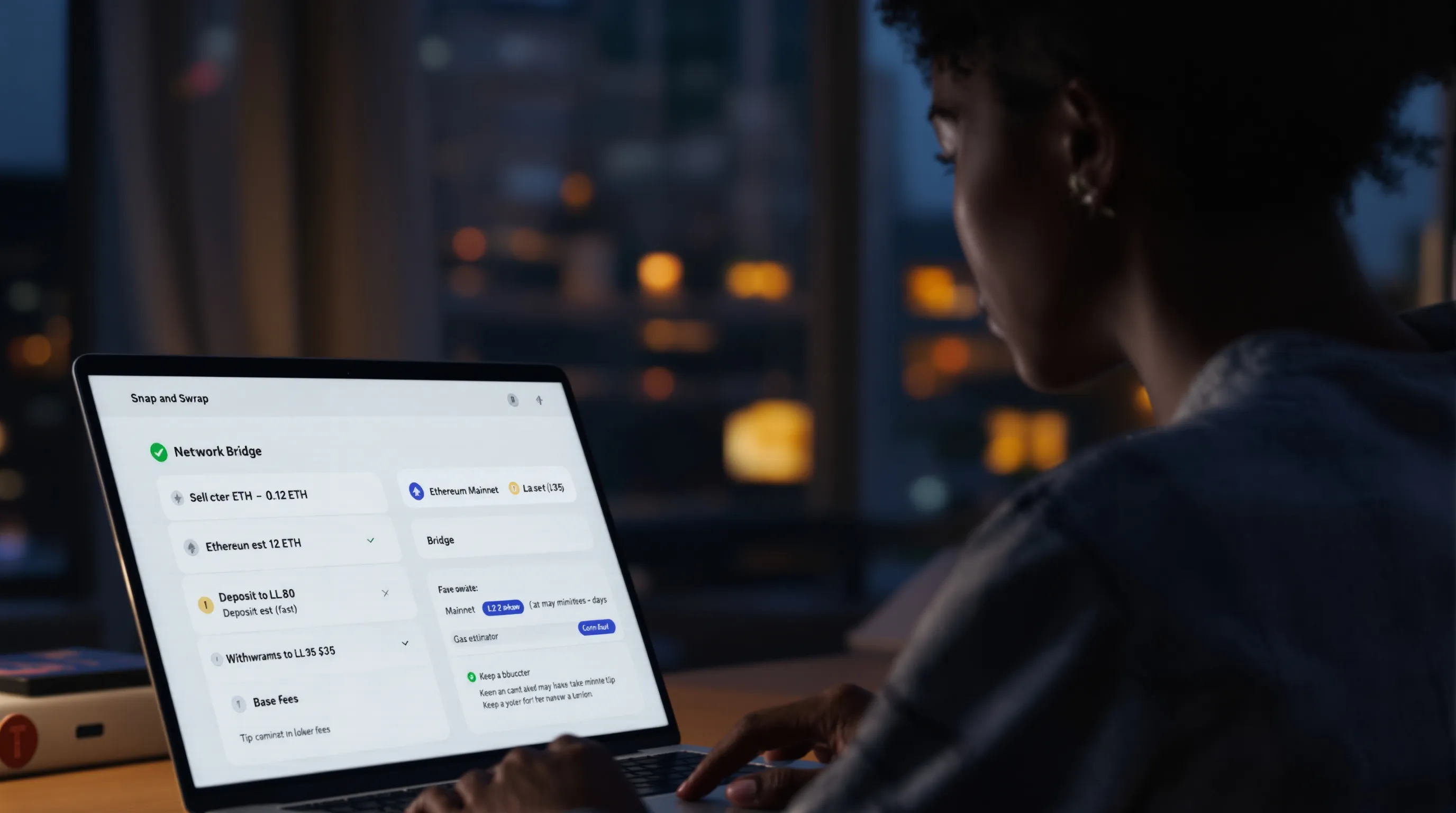
Acquire ETH For Gas (On-Ramp Or Exchange Transfer)
Why it matters: No ETH = no transactions.
- On-ramp: Buy ETH with a regulated provider (e.g., Coinbase, Kraken) or integrated on-ramps inside wallets where available.
- Transfer: Withdraw ETH from your exchange to your self-custody address. Start with a small test amount first.
- Confirm: After one or two confirmations, you’ll see ETH in your wallet.
Bridge To A Lower-Cost Layer-2 If Needed
Why it matters: Swapping on L2s is often far cheaper.
- Choose L2: Base, Arbitrum, and Optimism have low fees and strong Uniswap liquidity for major pairs.
- Bridge options: Use official bridges (e.g., Base Bridge) or reputable cross-chain bridges. Always verify URLs.
- Timing: Bridging from Ethereum to L2 is fast: withdrawals back to L1 can take longer (minutes to days) depending on the method.
Estimate Fees And Confirm You Have Enough For Gas + Swap
Why it matters: Underfunded wallets cause failed transactions.
- Check gas: Use your wallet’s fee estimator or sites like ethgasstation.info for L1, and built-in estimators on L2s.
- Buffer: Keep extra ETH for approvals, retries, and slightly volatile gas. On L2s, a few dollars often covers multiple actions.
- Sanity check: If fees exceed 1–2% of your trade size, consider smaller test swaps or switching networks/time of day.
Connect To Uniswap And Verify You’re In The Right Place
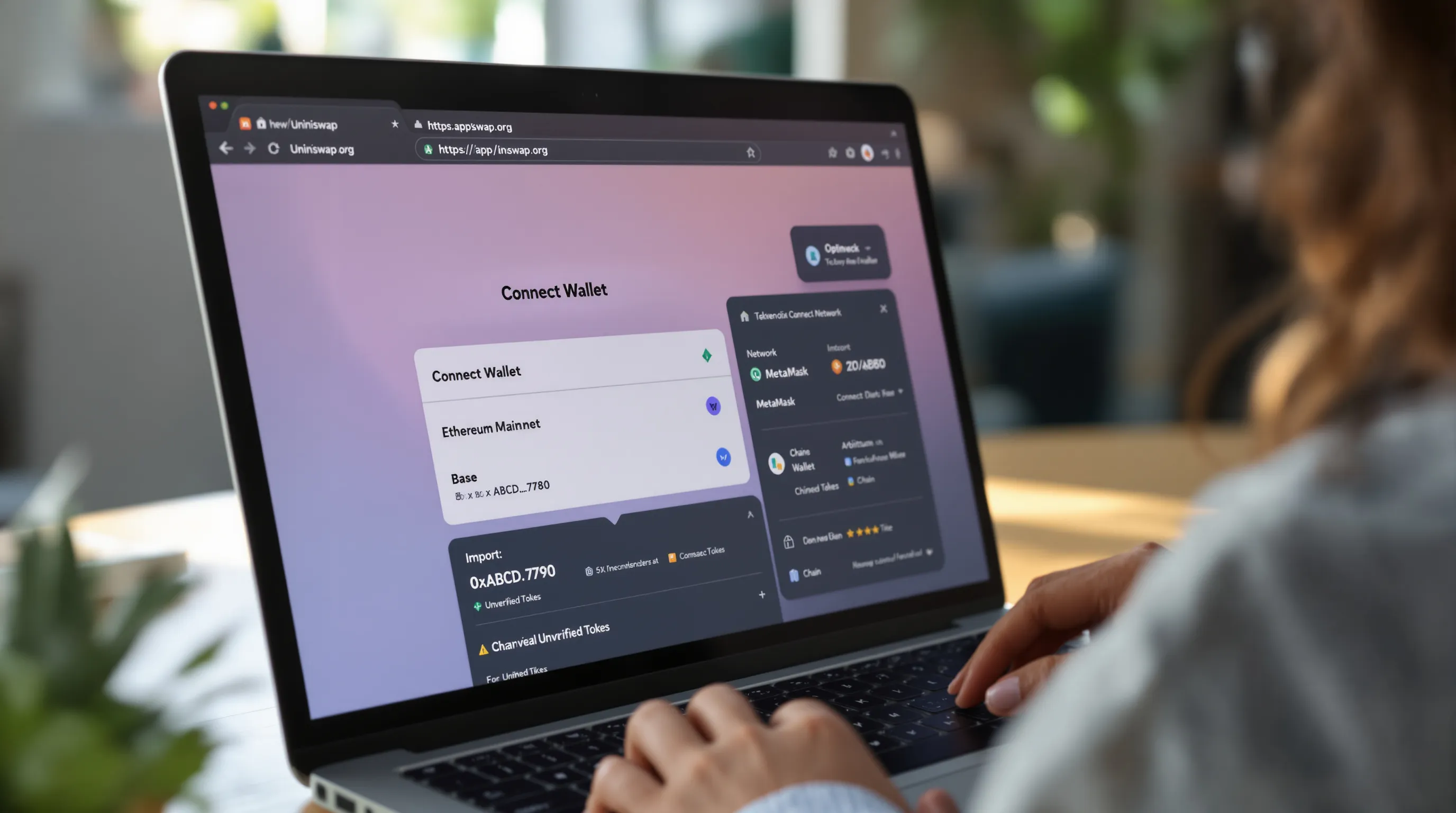
Go To The Official App And Connect Your Wallet
Why it matters: Phishing sites are common.
- URL: Navigate to the official Uniswap interface (app.uniswap.org). Bookmark it and avoid search ads.
- Connect: Click “Connect Wallet,” choose your wallet (MetaMask, Coinbase Wallet), and approve the connection.
Choose The Active Network (Mainnet Or L2)
Why it matters: Your wallet’s network must match the Uniswap network.
- Switch in wallet: Ensure your wallet is set to Ethereum, Base, Arbitrum, or Optimism, whichever you plan to use.
- Match in app: Select the same network in the Uniswap UI. If they mismatch, you’ll see errors or empty balances.
Verify Token Contract Addresses To Avoid Fakes
Why it matters: Anyone can create a token with the same name.
- Sources: Get the contract from the project’s official site, CoinGecko/CoinMarketCap verified pages, or the Uniswap default list where applicable.
- Double-check: Compare chain, decimals, and the first/last characters of the contract address.
- Tip: For new or illiquid tokens, cross-check community warnings and recent on-chain activity before swapping.
Make Your First Swap: Settings, Approvals, And Confirmation
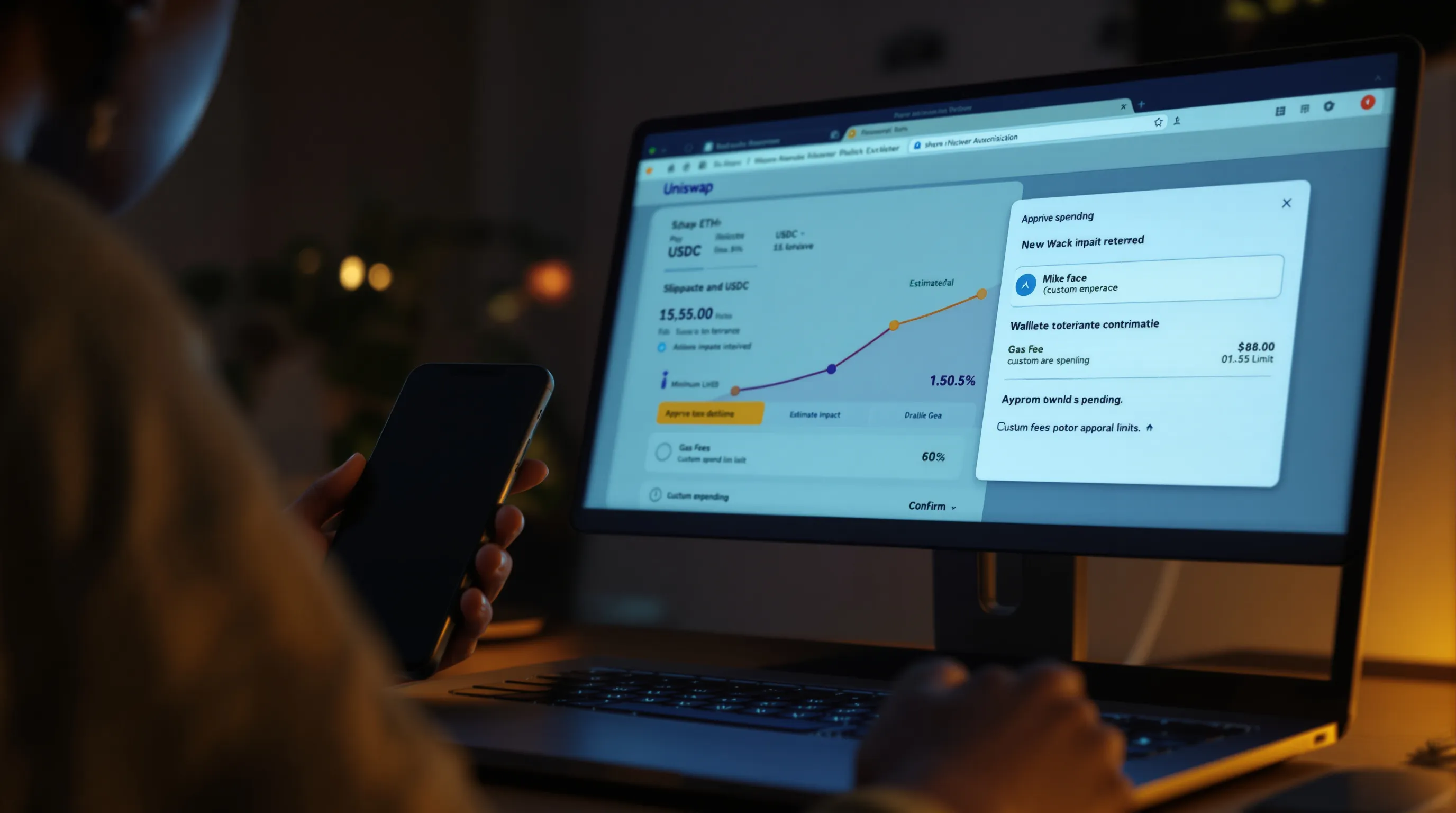
Enter Amounts And Review The Route And Quotes
Why it matters: Small details affect execution and cost.
- Select the token you’re paying with (e.g., ETH or USDC) and the token you want to receive.
- Enter the amount. Uniswap will show a route (single pool or multi-hop), estimated output, and fees.
- Check price impact and minimum received. Large trades relative to pool size cause higher impact.
Set Slippage Tolerance And Transaction Deadline
Why it matters: Protects you from unfavorable price moves.
- Slippage tolerance: Start with 0.5%–1% for major pairs: increase only if liquidity is low or tokens have transfer fees.
- Deadline: Set a few minutes to avoid stuck transactions in volatile markets.
- Pro tip: If your swap fails due to slippage, raise it gradually (e.g., 0.1% increments), not all at once.
Approve Token Allowance (One-Time) Safely
Why it matters: Approvals can be over-granted by default.
- When swapping an ERC-20 (e.g., USDC), you’ll approve spending before swapping.
- Use “custom spend limit” if available. Approve only what you intend to trade, especially for new dApps.
- You can revoke or lower allowances later using revoke tools or your wallet’s permissions manager.
Confirm The Swap, Pay Gas, And Track Status On A Block Explorer
Why it matters: Verification keeps you in control.
- Review the transaction in your wallet: gas fee, slippage, and amounts.
- Confirm to broadcast. On Ethereum, expect higher gas: on L2, it’s typically cents.
- Track on a block explorer: Etherscan, Basescan, Arbiscan, or Optimistic Etherscan. Look for “Success.”
- Funds received: Your new token appears in the wallet: you may need to “import” its token address to see the balance.
Troubleshoot Issues And Avoid Common Pitfalls
Fix Stuck Or Failed Transactions (Speed Up, Cancel, Re-send)
Why it matters: Efficient recovery saves time and gas.
- Speed up: If pending, use “speed up” to replace with a higher fee (same nonce, higher priority).
- Cancel: If safe to abandon, send a 0 ETH self-transaction with the same nonce at a higher fee to cancel.
- Re-send: After cancellation or failure, adjust slippage/fees and try again.
Handle Low Liquidity And High Price Impact
Why it matters: Illiquid pools can drain value.
- Check pool depth: If price impact >2–3%, consider splitting your trade into smaller chunks.
- Try another route/network: Different pairs or L2s may have deeper liquidity.
- Use a stable intermediary: Sometimes routing via a stablecoin (USDC/USDT) improves execution.
Reduce MEV/Front‑Running (Private RPC, Better Slippage)
Why it matters: Protects your price.
- Private RPC: Use wallet-integrated privacy RPCs or RPCs that support private transactions to avoid public mempool sniping.
- Tight slippage: Keep it as low as feasible for the pair.
- Time your swap: Avoid extreme volatility and hot mints when mempool activity spikes.
Review And Revoke Token Allowances Periodically
Why it matters: Limits exposure from approvals you no longer need.
- Audit quarterly: Use Etherscan’s token approvals, Revoke.cash, or your wallet’s dashboard.
- Revoke or reduce: Especially for inactive dApps or higher-risk tokens.
- Expect a small gas fee for each revoke.
Optimize Costs And Explore Next Steps
Compare Networks For Fees/Liquidity And Time Your Swaps
Why it matters: Fees can make or break small trades.
- Ethereum L1: Best depth for majors, higher gas. Good for larger trades where liquidity matters most.
- Base/Arbitrum/Optimism: Lower fees, strong routing for many pairs. Ideal for frequent or smaller trades.
- Timing: Weekends or off-peak hours often have lower L1 gas. Monitor gas trackers.
Try Gas-Optimized Or RFQ Swaps (e.g., UniswapX Where Available)
Why it matters: Better execution and fewer failed txs.
- UniswapX: An intent/RFQ-style system that can source off-chain liquidity and settle on-chain, potentially reducing gas or improving price.
- Availability: If offered in your region and for your pair, compare quotes vs. classic AMM routing.
- Always verify the route and final amount received.
Optional: Set Up A Limit Order Or Provide Liquidity (Know IL)
Why it matters: Advanced tools unlock more control and yield, with trade-offs.
- Limit orders: Use reputable third-party tools or supported interfaces to set target prices.
- Provide liquidity: Earn fees by becoming an LP. Understand impermanent loss (IL): If prices diverge, your LP value vs. holding can decrease.
- Start small: Use major pools to learn fee dynamics before scaling.
Compliance, Taxes, And Ongoing Security
Keep Records For Taxes And Cost Basis
Why it matters: U.S. tax reporting expects accurate records.
- Track every swap: Date/time, token amounts, USD value at execution, fees.
- Use tools: Portfolio/tax software that supports on-chain data can simplify Form 8949 reporting.
- Cost basis: Each swap can be a taxable event: consult a tax professional for specifics.
Understand Interface Restrictions And Token Risk Disclosures
Why it matters: Compliance and clarity.
- Geo/Compliance: Some interface features or tokens may be restricted by jurisdiction.
- Disclosures: Read Uniswap’s interface warnings: some tokens have transfer fees or risks that affect slippage/execution.
Maintain Security Hygiene (Phishing Checks, Updates, Hardware)
Why it matters: Most losses are preventable.
- Phishing: Always verify URLs, never sign blind messages, and distrust unsolicited “support.”
- Updates: Keep wallet, browser, and firmware (for hardware wallets) up to date.
- Cold storage: Keep long-term funds on a hardware wallet, and use a separate “hot” wallet for daily activity.
You’re ready. Start with a small test swap, verify on a block explorer, and scale as your confidence grows.