
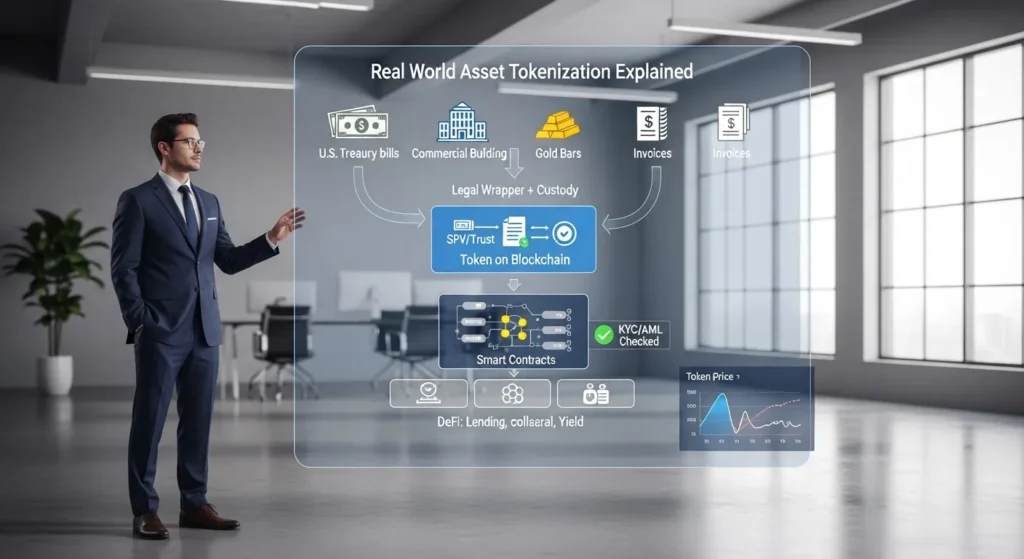
If crypto has ever felt like a closed loop, tokens trading against other tokens, real world asset tokenization is the plot twist that connects blockchains to stuff you can point at: Treasury bills, real estate, gold, invoices, even private credit.
And yes, it’s exactly what it sounds like: putting ownership (or rights to value) into a token so it can move around like software. Done well, it can make traditional assets easier to buy, sell, use as collateral, and settle. Done poorly… it can turn into a shiny wrapper around the same old risks.
In this guide, you’ll get real world asset tokenization explained in plain English: what it is, how the plumbing works end-to-end, why institutions are paying attention, what’s actually being tokenized today, and how to evaluate an RWA token before you touch it.
What Real World Asset (RWA) Tokenization Actually Means
Real world asset (RWA) tokenization is the process of converting rights to a physical or traditional financial asset into a blockchain-based token. In other words, a token becomes a programmable “receipt” (with rules) that represents your claim on something real, like a share of a fund holding Treasury bills, a slice of a building, or a portion of a loan portfolio.
Important nuance: tokenization usually doesn’t mean the building itself is “on-chain.” It means your ownership rights (or economic rights) are represented on-chain, and the legal + custody structure is what makes that token mean anything in the real world.
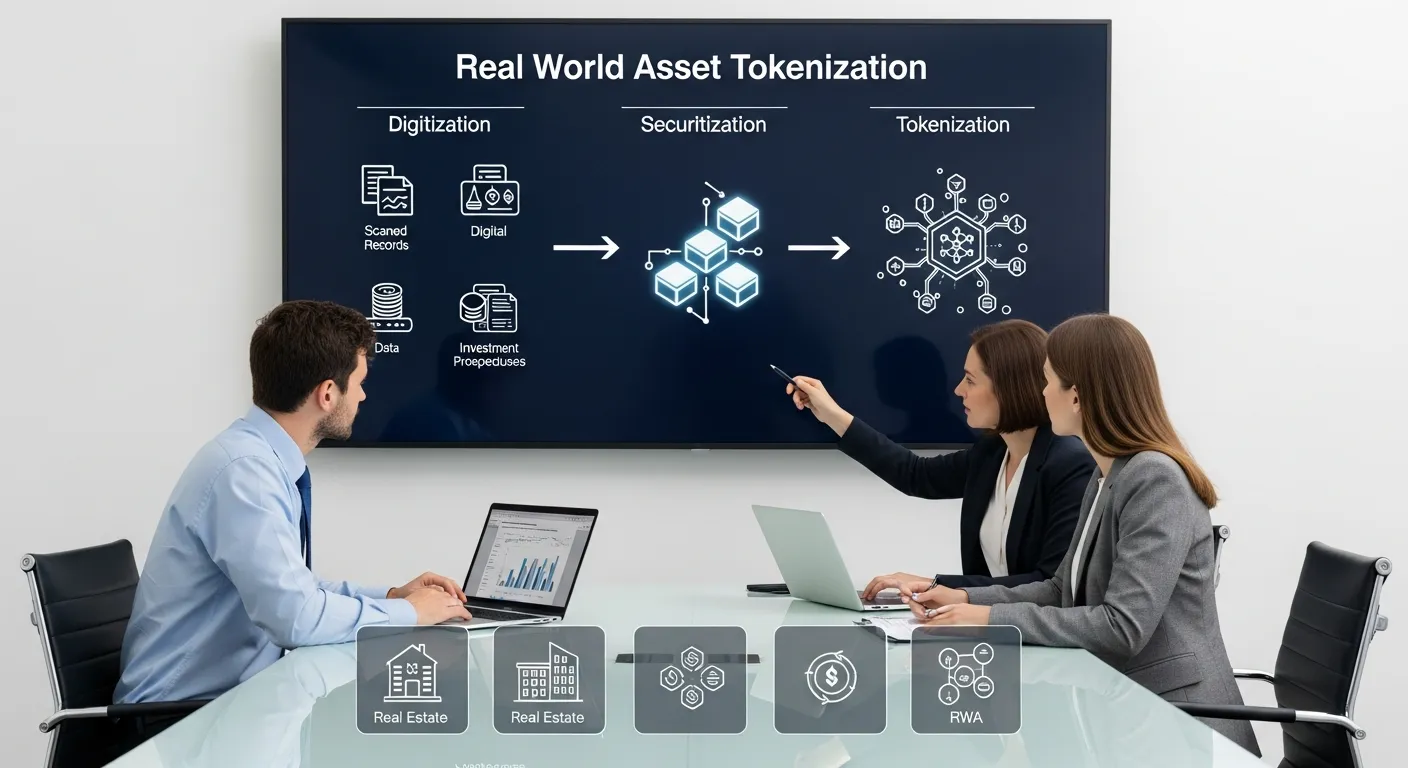
Tokenization Vs. Digitization Vs. Securitization
These three get mixed up constantly, so here’s the clean separation:
- Digitization: You’re just making records digital. Think PDFs, spreadsheets, a database entry at a transfer agent. It’s still traditional plumbing.
- Securitization: You’re packaging cash flows into an investable security (like asset-backed securities). This can exist with or without blockchain.
- Tokenization: You’re representing ownership/economic rights as tokens on a blockchain, so transfers, compliance rules, and settlements can be automated via smart contracts.
A helpful way to think about it: digitization is “put it on a screen,” securitization is “turn it into a product,” and tokenization is “turn it into software.”
What Counts As A “Real World Asset” In Crypto
In crypto, “RWA” is basically shorthand for: anything with value that exists outside the chain, but can be represented on the chain. Common buckets include:
- Real estate (homes, commercial buildings, land)
- Commodities (gold, oil, agricultural products)
- Financial instruments (Treasury bills, bonds, equities, funds)
- Private credit / receivables (loans, invoices, revenue-based financing)
- Alternative assets (art, collectibles)
The bigger question isn’t “can it be tokenized?” (theoretically, lots can). The real question is: can it be tokenized in a way that’s legally enforceable, auditable, and redeemable?
How RWA Tokenization Works End To End
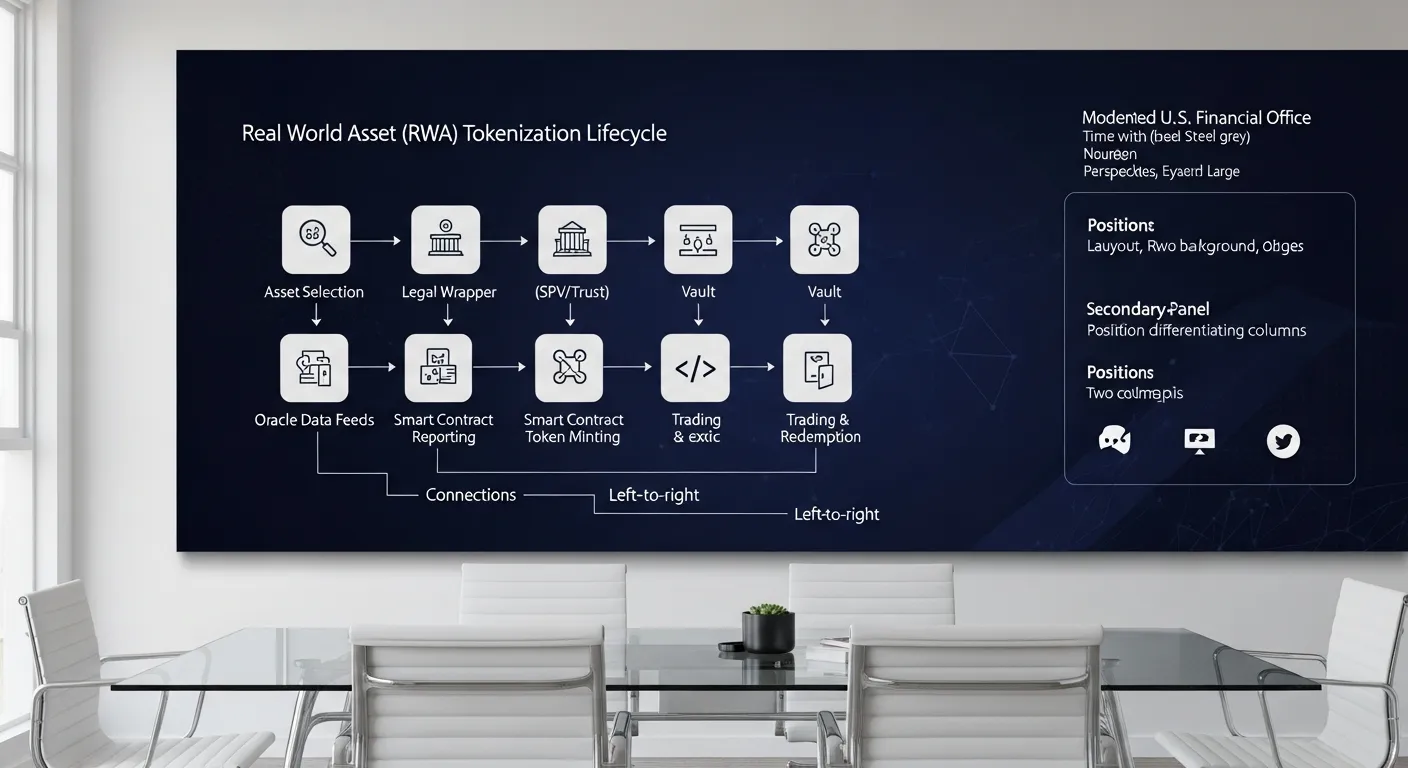
If you zoom out, most tokenized RWA systems follow a pretty consistent playbook:
- Pick the asset (or asset pool)
- Wrap it in a legal structure
- Put custody and reporting in place
- Mint tokens representing rights
- Enable trading (sometimes)
- Enable redemption (almost always, if it’s legit)
Here’s what’s happening under the hood.
The Core Building Blocks: Legal Wrapper, Custody, Oracles, And Smart Contracts
Legal wrapper
- This is the “so what?” layer. A token is only meaningful if there’s a legally recognized entity/contract that says token holders have specific rights.
- Common structures include SPVs (special purpose vehicles), trusts, or fund structures, usually chosen based on jurisdiction and regulatory constraints.
Custody
- Someone has to hold the underlying asset (or control the bank/brokerage account holding it).
- For Treasuries, custody might be through a regulated broker/custodian. For real estate, an entity owns the property and token holders own shares/claims.
Oracles
- Smart contracts can’t “see” the real world by default. Oracles feed them data: NAVs, interest accrued, FX rates, proof-of-reserves signals, corporate actions, etc.
- If oracle data is wrong or delayed, you can get pricing distortions or, even worse, broken redemptions.
Smart contracts
- These handle issuance, transfers, compliance rules (like whitelisting), corporate actions (distributions), and sometimes redemption logic.
- The promise: fewer manual reconciliations and faster settlement. The tradeoff: code risk.
Issuance, Trading, And Redemption: The Typical Lifecycle
Most RWAs have three phases:
- Issuance: Tokens are minted and sold to investors (or allocated to depositors). This can include eligibility checks like KYC/AML and accreditation.
- Trading: Tokens may trade peer-to-peer, on approved venues, or inside permissioned systems. Some are transferable only among whitelisted wallets.
- Redemption: You burn/return the token and receive the underlying value, cash, the asset itself, or a distribution.
A practical mental model: issuance is “getting in,” trading is “moving around,” redemption is “getting out.” If redemption is unclear, be cautious. In RWAs, the exit door matters.
On-Chain RWAs Vs. Off-Chain Settlement Models
Not all “tokenized” assets are equally on-chain.
- On-chain RWAs (stronger on-chain guarantees): Transfers and ownership records live on-chain, and the system is designed so on-chain state closely matches legal/financial reality.
- Off-chain settlement (weaker on-chain guarantees): The token is more like a tracker or IOU, while real settlement happens off-chain in traditional ledgers.
Many real products are hybrids. And that’s not automatically bad, trad finance rules exist for a reason. You just want clarity on which parts are actually enforced by smart contracts vs. enforced by lawyers and administrators (and whether you trust that stack).
Why Investors And Institutions Care
Institutions aren’t exploring RWAs because they love memes (although… give it time). They care because tokenization can improve market structure: liquidity, settlement, transparency, and new financial “lego” compatibility with DeFi.
Liquidity, Fractional Ownership, And 24/7 Markets
RWAs often suffer from “rich-person sizing.” Buying a building, a private credit deal, or even certain funds can require big minimums and lots of paperwork.
Tokenization can change that by:
- Enabling fractional ownership (buy $100 worth, not $100,000)
- Potentially improving liquidity via secondary trading
- Moving toward 24/7 global markets (especially for instruments that can be created/redeemed on demand)
Reality check: not every tokenized asset becomes liquid. If there aren’t enough buyers and sellers, you’ll still have a wide spread and a slow exit. Tokenization can enable liquidity, but it can’t magically summon it.
Transparency, Auditability, And Faster Settlement
On public blockchains, ownership transfers are visible and timestamped. That can make auditing and reconciliation simpler, at least for the on-chain portion.
Institutions also care about settlement speed. Traditional markets can take a day or more to settle (and even when they’re faster, the stack is complicated). With tokenized RWAs, you can push toward near-real-time settlement and reduce the number of intermediaries.
If you want a deeper view on market infrastructure trends, research firms like Messari often publish primers and sector reports that map out how these systems are evolving.
New DeFi Use Cases: Collateral, Yield, And Composability
This is where things get interesting.
Tokenized RWAs can be used in DeFi as:
- Collateral for loans
- Yield-bearing building blocks (e.g., tokenized T-bills as a “risk-off” leg)
- Composable assets that plug into AMMs, lending markets, structured products, or treasury management tools
Here’s a simple picture of the appeal: DeFi has great rails but historically shaky collateral. RWAs have widely understood collateral but historically clunky rails. Tokenization is an attempt to marry the two.
Common RWA Categories And Realistic Examples
Tokenization sounds futuristic until you realize the most popular RWAs today are pretty… traditional. Boring, even. Which is kind of the point.
Treasury Bills And Money Market Funds
Tokenized exposure to short-term U.S. Treasuries has become one of the flagship RWA use cases because:
- Treasuries are widely trusted
- Yield is easy to understand (interest from government debt)
- Valuation and liquidity are relatively straightforward
Typically, you’re not buying a specific Treasury CUSIP directly on-chain. You’re getting tokenized shares/claims on a structure (like a fund or SPV) that holds Treasuries at a custodian.
To sanity-check rates and the macro backdrop, you can cross-reference policy and yield data from the Federal Reserve and market dashboards from providers like CoinMarketCap for on-chain token tracking.
Private Credit And Receivables
Private credit is a big deal in traditional finance and is increasingly showing up in RWA tokenization. This can include:
- Short-duration business loans
- Trade finance
- Invoice/receivables financing
The pitch: investors get yield that isn’t purely crypto-native. The reality: you’re taking on underwriting risk, servicing risk, and often meaningful counterparty risk. Unlike Treasuries, you’re relying on humans and companies to pay.
If you’re serious about this category, look for performance reporting and default history. Also, crypto analytics firms like Chainalysis are useful for understanding on-chain risk and flows around major entities.
Real Estate, Commodities, And Alternative Assets
These are the headline-grabbers:
- Real estate: tokens represent shares in an entity that owns a property: returns may come from rent and appreciation.
- Commodities (like gold): tokens represent claims on vaulted inventory.
- Alternatives (art/collectibles): tricky, because valuation and liquidity can be… vibes-based.
A realistic expectation: tokenization can make ownership easier to transfer, but it doesn’t automatically solve property management, insurance, taxes, or the fact that selling a building is still a process.
A quick “RWA realism” table
| RWA type | What you’re really buying | Main upside | Main gotcha |
|---|---|---|---|
| Tokenized T-bills | Claim on a structure holding Treasuries | Cleaner yield + settlement | KYC, redemption rules, custodian reliance |
| Private credit | Exposure to loan cash flows | Higher yield potential | Defaults + servicing + opacity |
| Real estate | Shares/claims on property entity | Fractional access | Illiquidity + legal complexity |
| Gold/commodities | Claim on vaulted inventory | Easier transfer | Proof-of-reserves + redemption logistics |
Risks, Tradeoffs, And Failure Modes To Watch
RWAs blend two worlds, so you inherit problems from both: traditional finance risks and smart contract risks. If you remember one thing, make it this: a token can’t bulldoze reality.
Counterparty And Custody Risk: Who Holds The Asset, Really
Ask the slightly awkward question: who is the adult in the room holding the asset?
Common failure modes include:
- Custodian insolvency or operational failure
- Asset encumbrance (the asset is pledged elsewhere)
- Weak segregation (assets not properly ring-fenced from issuer balance sheet)
- Poor reporting (you can’t verify holdings or cash flows)
Even if the token transfer is flawless, your claim is only as strong as the custody and legal structure behind it.
Legal And Regulatory Risk: Securities Laws, KYC/AML, And Jurisdiction
A lot of RWAs look like securities because… they usually are.
Things that can bite you:
- Securities law compliance (registration exemptions, disclosures, transfer restrictions)
- KYC/AML requirements (who can hold it, where they live)
- Jurisdiction shopping (issuer in one country, assets in another, investors everywhere)
In the U.S., rules can change via enforcement, guidance, and court decisions, so “regulatory clarity” is often more like “regulatory weather.” You can still invest, but you should price in uncertainty.
Smart Contract, Oracle, And Depegging Risk
Even if the underlying asset is rock-solid, the token can misbehave.
Watch for:
- Smart contract bugs (frozen funds, incorrect accounting, exploits)
- Oracle failures (wrong NAV, stale pricing, manipulation)
- Depegging (token trades below expected value due to panic, liquidity issues, or redemption friction)
A tokenized T-bill product can still trade at a discount if redemptions are slow, restricted, or expensive. Markets don’t like waiting, especially crypto markets.
How To Evaluate A Tokenized RWA Before You Invest
If you’re used to evaluating crypto tokens, RWAs require a mindset shift. You’re not just analyzing tokenomics, you’re underwriting structures, contracts, and counterparties.
Due Diligence Checklist: Issuer, Structure, Disclosures, And Audits
Here’s a practical checklist you can actually use:
- Who is the issuer? Real company? Track record? Named executives? Regulatory registrations?
- What’s the legal structure? SPV, trust, fund? What rights do token holders have, equity, debt, profit share, redemption claim?
- Where are the assets held? Which custodian/bank/broker? Are assets segregated?
- What disclosures exist? Offering docs, risk factors, financial statements, portfolio composition.
- Any audits or attestations? Smart contract audits (from reputable firms) and asset attestations/proof-of-reserves style reporting.
If the project can’t clearly explain those points in plain English, that’s your sign to step back.
Liquidity And Market Structure: Venues, Lockups, And Redemption Terms
Don’t just ask “Can I sell it?” Ask how you sell it.
Key questions:
- Is there a secondary market? On what venue(s)?
- Are transfers permissioned (whitelisting)?
- Are there lockups or limited trading windows?
- What are redemption minimums, fees, and timelines?
- Is redemption “best effort,” or contractually defined?
A token can be technically transferable but practically illiquid, like having a spare key to a door that’s welded shut.
Yield Quality: Where Returns Come From And What Could Break
Yield is where hype sneaks in, so slow down here.
Ask:
- What’s the yield source? Treasury interest, borrower payments, rent, trading strategies?
- Is yield net of fees and losses? Management fees, servicing fees, insurance, legal costs.
- What assumptions are baked in? Default rates, vacancy rates, refinancing ability.
- What breaks in a downturn? Correlations go to 1 when things get stressful.
A healthy mindset: If the yield looks too smooth, you might just be looking at delayed recognition of risk.
Conclusion
Real world asset tokenization is one of the most practical bridges between Wall Street and Web3: taking familiar assets, Treasury bills, credit, real estate, and giving them blockchain rails so they can settle faster, trade more flexibly, and plug into DeFi.
But the token isn’t the magic. The magic (or the mess) is in the structure: the legal wrapper, the custodian, the redemption mechanics, the oracle data, and the contracts you’re trusting.
If you’re exploring RWAs in your own portfolio, start boring: understand the asset, confirm who holds it, read the redemption terms, and treat “on-chain” as a transparency tool, not a guarantee.
The big forward-looking question is simple: as tokenized Treasuries and credit grow, will DeFi become a serious distribution layer for real-world yield, or will regulation and fragmented standards keep RWAs mostly permissioned and walled off?
Disclaimer: This content is for informational purposes only and does not constitute financial or investment advice.