

AI and crypto are converging fast, and 2025 looks like a breakout year for decentralized compute, data, and agent markets. In this guide to the top AI crypto coins to watch in 2025, we highlight the projects building real infrastructure, GPUs, storage, indexing, and agent economies, so we can separate signal from noise. We’ll share the core thesis for each project in one line, the biggest risk to watch, and the catalysts that could move markets. None of this is financial advice, but it’s the framework we use to track where AI x Web3 utility is actually growing.
1. ASI (Artificial Superintelligence Alliance): Agents, Data, And Open AI Markets
What It Is
ASI aims to create a decentralized network for building, trading, and coordinating AI agents, models, and datasets across open markets, so anyone can compose AI systems without relying on a single provider.
Why It Matters For AI
Thesis: ASI is a bet on open AI agent economies, if autonomous agents and composable model markets go mainstream, the network could become a core coordination layer.
It matters because agentic workflows (think bots negotiating tasks, paying for data, and chaining models) need neutral rails for discovery, settlement, and reputation. An open marketplace reduces dependency on closed platforms and could unlock long-tail innovation.
2025 Catalysts To Watch
- Launches of decentralized agent marketplaces and SDKs for agent orchestration.
- Integrations with major L1/L2s for payments, identity, and provenance.
- Partnerships with AI research labs and data providers to seed high-quality supply.
Key Risks
Risk note: Heavy technical complexity and regulatory uncertainty around autonomous agents could slow adoption and throttle liquidity early on.
2. Bittensor (TAO): Open Marketplace For Machine Intelligence

What It Is
Bittensor is a decentralized network of specialized subnets where contributors train and serve machine learning models, earning TAO for useful outputs validated by the network.
Network Health Metrics
Thesis: If Bittensor continues to attract productive subnets and measurable utility, TAO could become a core unit of account for open machine intelligence.
Indicators to watch include active subnets (now well over 100), model diversity (NLP, retrieval, vision, agents), validator quality, and the value secured across the protocol.
2025 Catalysts To Watch
- Expansion and pruning of subnets to reward high-signal models.
- Adoption of Dynamic TAO (dTAO) to fine-tune incentives toward real usefulness.
- Institutional partnerships and enterprise inference pipelines.
Key Risks
Risk note: Coordinating incentives across subnets and securing against sybil/quality attacks is non-trivial, and heightened regulatory scrutiny could add friction.
3. Render (RNDR): Decentralized GPU For Rendering And AI Inference

What It Is
Render connects GPU providers with users who need high-performance rendering and, increasingly, AI inference and training, using RNDR to coordinate payments and incentives.
Adoption Signals
Thesis: If demand for AI inference and 3D/AI content creation keeps climbing, a liquid, decentralized GPU marketplace like Render can capture that spending.
Signals include usage by creative studios and AI startups, geographic expansion of nodes, and improvements to job routing for latency-sensitive workloads.
2025 Catalysts To Watch
- Deeper integrations with AI frameworks and model hubs.
- Tokenomics updates that align long-term supply with network growth.
- Partnerships with media and gaming giants to secure enterprise workloads.
Key Risks
Risk note: Compute markets are competitive, centralized clouds, provider concentration, and cyclical demand could compress margins and token utility.
4. Akash (AKT): Decentralized Cloud And GPU Market
What It Is
Akash is a permissionless marketplace for cloud compute and GPUs, letting developers deploy AI/ML workloads at potentially lower cost than centralized providers.
Usage And Revenue Indicators
Thesis: If Akash can keep growing reliable supply and real workload deployments, it becomes a credible alternative cloud for AI builders.
We’re watching on-chain deployments, the growth of GPU providers, pricing competitiveness, and protocol revenue as leading indicators of sticky demand.
2025 Catalysts To Watch
- Native integrations with popular AI stacks (PyTorch, TensorRT, inference servers).
- Network upgrades that improve scheduling, reliability, and developer experience.
- Grants and partnerships to onboard research labs and startups.
Key Risks
Risk note: Provider reliability and UX parity with hyperscalers are hard: tokenomics need to sustainably reward supply without overpaying.
5. io.net (IO): Solana-Native Distributed GPU Network
What It Is
io.net uses Solana’s high-throughput chain to coordinate distributed GPU clusters for AI inference and training, aiming for low-latency, low-cost compute at scale.
Growth And Reliability Metrics
Thesis: With Solana’s speed and cost advantages, io.net can carve out a niche for real-time AI apps that need fast settlement and resilient compute.
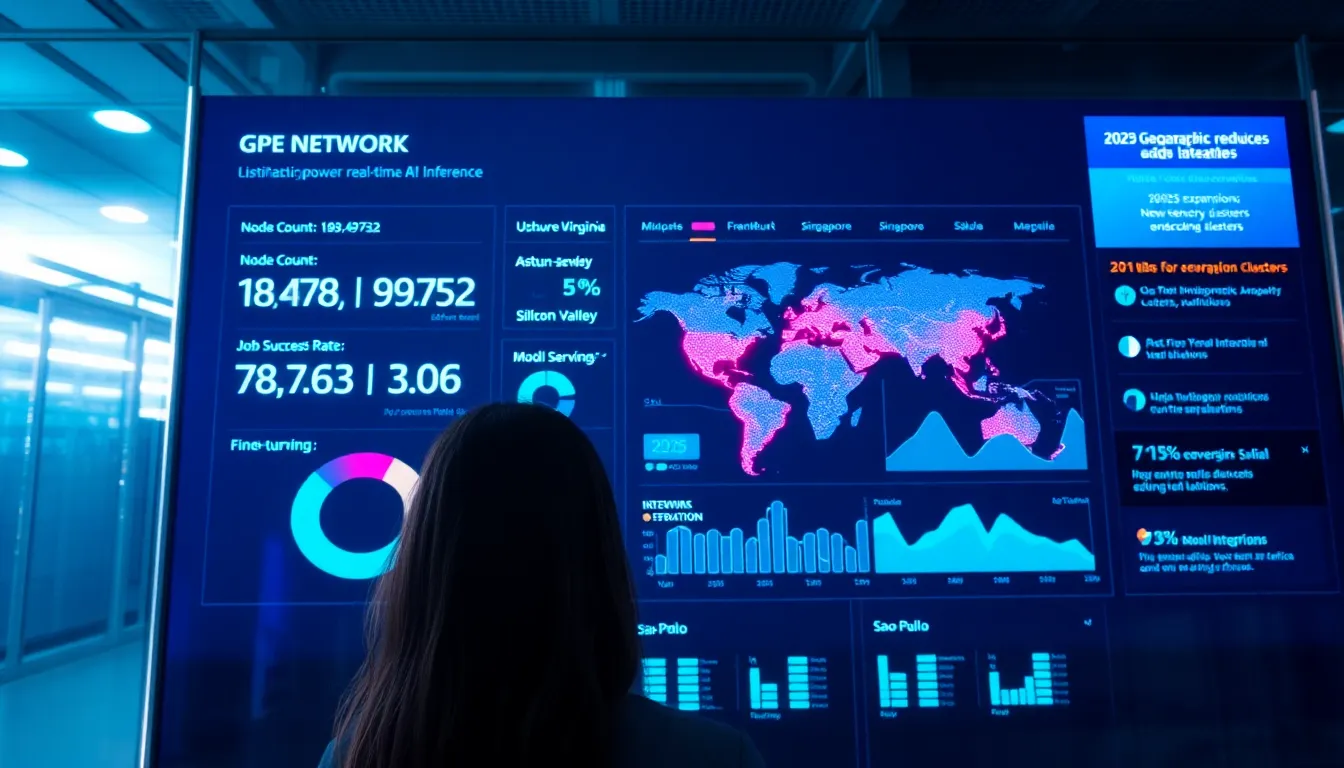
We’re tracking node counts, uptime, job success rates, and case studies from AI labs using the network for production inference.
2025 Catalysts To Watch
- Expansion into new geographic clusters to reduce latency.
- Partnerships with AI tooling providers (fine-tuning, serving, MLOps).
- Reliability improvements and SLAs for enterprise workloads.
Key Risks
Risk note: Dependence on Solana’s network stability, hardware underutilization, and competition from multi-chain GPU markets could pressure growth.
6. Livepeer (LPT): AI Video Transcoding And Media Compute
What It Is
Livepeer is a decentralized video infrastructure network for transcoding and, increasingly, AI-powered video analytics, moderation, and search.
Real-World Demand Signals
Thesis: If short-form video, streaming, and AI media analytics keep exploding, Livepeer’s specialized compute could capture a durable slice of spend.
We’re watching node expansion, minutes processed, integrations with streaming platforms, and growth in AI features like scene detection or automated highlights.
2025 Catalysts To Watch
- New AI video services (captioning, content safety, generative effects).
- Partnerships with Web3 social and creator platforms.
- Deeper penetration into IPTV/OTT with cost and performance wins.
Key Risks
Risk note: Centralized CDNs and clouds are formidable: token demand can be cyclical, and scaling real-time video plus AI is operationally tough.
7. The Graph (GRT): Data Indexing Layer Powering AI And Web3 Apps
What It Is
The Graph is a decentralized protocol for indexing and querying blockchain data via subgraphs, increasingly vital for AI agents and analytics that need on-chain context.
Ecosystem Momentum Indicators
Thesis: If AI agents and dApps require fast, reliable on-chain data, The Graph’s indexing layer becomes core infrastructure with compounding network effects.
Key indicators: growth in subgraphs, query volumes, indexer distribution, and partnerships with leading DeFi, NFT, and gaming apps.
2025 Catalysts To Watch
- More efficient indexing, cross-chain coverage, and L2-native deployments.
- New token utilities aligned to data quality, freshness, and availability.
- AI-focused data services (feature stores, provenance metadata).
Key Risks
Risk note: Centralization among indexers, API reliability, and fragmentation across chains could limit performance and developer trust.
8. Arweave (AR): Permanent Data Backbone For AI Datasets
What It Is
Arweave provides permanent, tamper-resistant storage well-suited for AI datasets, model checkpoints, and provenance records that need to outlive any single provider.
Adoption And Monetization Signals
Thesis: As AI shifts toward verifiable data pipelines, permanent storage with provenance could make Arweave the “hard drive” for open AI.
Signals include rising storage volumes, permaweb tooling improvements, and pay-per-use models that make large dataset hosting economic.
2025 Catalysts To Watch
- Integrations with AI platforms for dataset hosting and model artifact storage.
- Monetization schemes for data providers and curators.
- Growth in public datasets for research and transparent training.
Key Risks
Risk note: Storage cost dynamics, usage volatility, and competing decentralized or centralized storage options may squeeze margins and demand.