

If you’ve ever tried to do something simple on Ethereum, swap a token, mint an NFT, move funds to a DeFi app, and got hit with a fee that made you double-check the decimal… yeah. That’s the “Ethereum is popular” tax.
ZK rollups are one of the cleanest fixes we’ve got right now: they move most of the work off Ethereum, then come back with a tiny mathematical receipt that basically says, “Trust me, the math checks out.” And the best part? Ethereum still enforces the rules.
In this guide, you’ll get a plain-English breakdown of what zk rollups are, how they work step by step, how they compare to optimistic rollups, what they’re great at (and still bad at), and how to use them safely without learning the hard way.
Why Ethereum Needs Rollups In The First Place
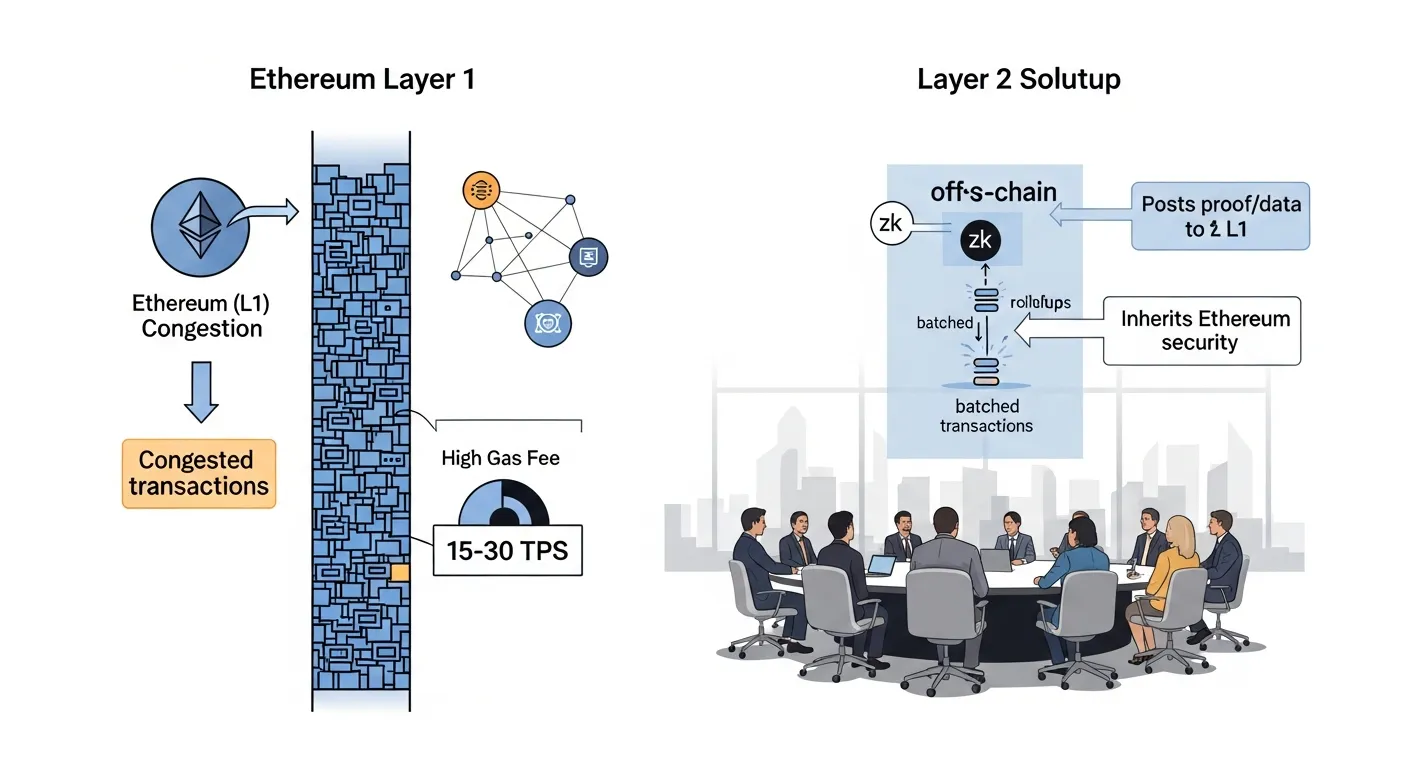
Ethereum’s Layer 1 is the most battle-tested smart contract platform, but it has a very “New York City subway at rush hour” problem: too many people trying to use the same narrow lanes.
Here’s the core issue:
- Ethereum processes roughly ~15–30 transactions per second (TPS) depending on what’s being executed and network conditions.
- Every transaction competes for limited block space.
- When demand spikes (NFT mints, meme coin seasons, market volatility), gas fees climb because users bid against each other.
So why not just make Ethereum blocks bigger or crank TPS way up on Layer 1?
Because Ethereum is built to be decentralized and verifiable. If you make the chain too “heavy,” fewer people can run nodes, and the network becomes easier to centralize. The whole point is that Ethereum stays credible even when nobody’s in charge.
That’s where rollups come in.
A rollup is a Layer 2 scaling solution that:
- Executes transactions off-chain (so you’re not paying L1 prices for every little computation)
- Batches lots of activity together
- Posts enough information back to Ethereum so Ethereum can still secure the result
You’ll often hear the phrase: “Rollups inherit Ethereum security.” That’s the big sell. You get cheaper, faster transactions, without switching to a totally separate chain with its own security assumptions.
If you want a reference point for network activity and fees over time, CoinMarketCap’s overview pages and dashboards are a decent starting spot for market context, while deeper on-chain data often comes from analytics firms like Glassnode and Chainalysis (especially for adoption and security trends).
What A ZK Rollup Is (In Plain English)
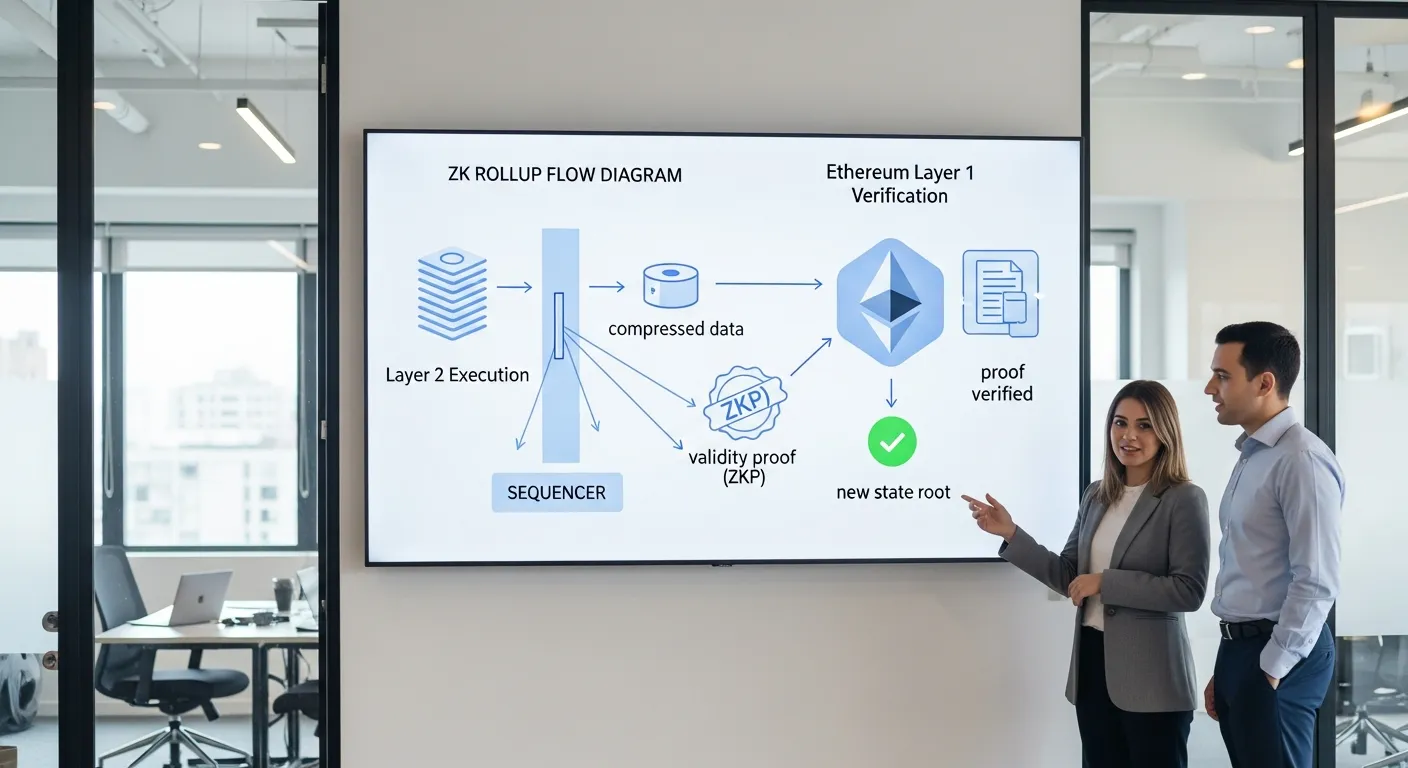
A ZK rollup is a rollup that uses zero-knowledge proofs (ZKPs) to prove that a batch of transactions is valid.
In human terms:
- Instead of asking Ethereum to re-run every transaction (expensive),
- the rollup says, “Here’s the new result, and here’s a proof that we followed the rules.”
Ethereum verifies the proof quickly, updates the rollup‘s official state, and moves on.
The Core Idea: Proofs Instead Of Trust
This is the part that makes zk rollups feel almost like magic.
A zero-knowledge proof is a cryptographic proof that lets someone prove a statement is true without revealing every detail.
For zk rollups, the statement is basically:
“Given the previous state, and given these transactions, the new state is correct according to the rollup‘s rules.”
Common proof systems you’ll see mentioned include zk-SNARKs and zk-STARKs. You don’t need to memorize the acronyms, just know the vibe:
- They’re mathematical proofs, not “trust me bro.”
- Ethereum can verify them cheaply compared to executing everything on-chain.
So even if you don’t trust the rollup operator (sequencer), Ethereum won’t accept an invalid update because the proof won’t verify.
Where Transactions Happen And What Gets Posted On-Chain
In a zk rollup, most of the action happens off-chain:
- You send transactions to the rollup (often through a sequencer, which orders and batches transactions).
- The rollup executes those transactions in its own environment (Layer 2).
Then, on Ethereum (Layer 1), the rollup posts a few key things:
- A compressed batch of transaction data (often as calldata or a similar data-availability method)
- A validity proof (ZKP)
- A new state root (think of it as a cryptographic fingerprint of the rollup‘s updated balances and contract storage)
That on-chain data is what anchors the rollup to Ethereum’s security. Ethereum becomes the judge: if the proof checks out, the update becomes official.
If you want to go one level deeper later, most major zk rollups publish docs and audit links. Examples of projects in this category include zkSync, Scroll, and Polygon zkEVM, each with different design tradeoffs and levels of EVM compatibility.
How ZK Rollups Work Step By Step
Let’s walk through the full flow. No hand-waving.
Batching Transactions Into A Single Rollup Block
Instead of Ethereum handling each transaction individually, a zk rollup collects a bunch of them, sometimes hundreds or thousands, and packs them into a single batch.
A typical flow looks like this:
- You submit a transaction on the L2 (swap, send, mint, whatever).
- The sequencer accepts it and queues it with other users’ transactions.
- The rollup executes them off-chain and produces an updated state.
This “batching” matters because it spreads Layer 1 costs across many users.
If posting to Ethereum costs (for easy numbers) $10 worth of gas for the batch, and that batch contains 1,000 transactions, then the L1 cost per transaction becomes tiny, before you even factor in compression.
Generating And Verifying A Zero-Knowledge Proof
After executing the batch, the rollup generates a validity proof.
This is the expensive part, but it’s expensive off-chain, where you can throw hardware and optimization at it.
Then:
- The rollup submits the batch data + proof to an Ethereum smart contract.
- Ethereum runs a verification step.
Verification is usually fast and relatively cheap compared to re-executing the whole batch. That’s the big win: hard work off-chain, cheap check on-chain.
A simple analogy: imagine filing taxes.
- Doing the taxes = painful (off-chain proving)
- IRS checking the math on your return = much simpler (on-chain verification)
Not a perfect comparison, but you get it.
Finalizing State Updates On Ethereum
Once Ethereum verifies the proof:
- The rollup‘s Ethereum contract accepts the new state root.
- That update becomes final according to Ethereum’s consensus.
This is why people say zk rollups can have fast finality and faster withdrawals compared to optimistic rollups. There isn’t a long “wait and see if someone challenges this” period, validity is proven up front.
One nuance: different rollups carry out withdrawals and bridging UX differently. Even if the proof finalizes quickly, your “withdrawal speed” might still depend on bridge design, liquidity, or how the app routes exits. So “near-instant” is often true technically, but the user experience can vary.
ZK Rollups Vs Optimistic Rollups: The Differences That Matter
ZK rollups aren’t the only rollups. The other major family is optimistic rollups (like Arbitrum and Optimism). They’re both legit, just different philosophies.
Here’s the cleanest way to think about it:
- Optimistic rollups assume transactions are valid by default (“optimistically”), and only prove fraud if someone challenges.
- ZK rollups prove validity every time using cryptography.
Security Model And Withdrawal Times
With optimistic rollups, there’s typically a challenge window (commonly around 7 days) where someone can submit a fraud proof if the rollup posted an invalid state update.
That has a direct user impact:
- If you want to withdraw from L2 back to Ethereum L1 through the canonical bridge, you may wait days.
- Many users avoid the wait by using liquidity bridges, but then you’re taking on bridge and liquidity-provider risk.
With zk rollups:
- Validity is proven immediately (or close to it).
- That generally enables faster finality and quicker withdrawals, because Ethereum accepts the update only if the proof verifies.
So the security vibe differs:
- Optimistic: “Valid unless proven otherwise.”
- ZK: “Valid because we proved it.”
Fees, Throughput, And User Experience Tradeoffs
This part is less “winner takes all” and more “pick your tradeoff.”
ZK rollups often:
- Have excellent throughput potential
- Can offer lower fees at scale because batches compress well and verification is efficient
- But face high proving costs and engineering complexity
Optimistic rollups often:
- Are more EVM-native today (meaning Ethereum apps can port over more easily)
- Have simpler infrastructure (no heavy proving step)
- But deal with withdrawal delays and rely on fraud-proof systems being robust in practice
Here’s a quick comparison table you can screenshot for later:
| Feature | ZK Rollups | Optimistic Rollups |
|---|---|---|
| Validity | Proven with ZKPs | Assumed, then challengeable |
| Withdrawals (canonical) | Typically faster | Often delayed (challenge window) |
| Dev compatibility | Improving fast (zkEVMs), still nuanced | Generally easier today |
| Cost profile | Proving is costly but shared: can get very efficient | Often cheaper to operate: data costs still matter |
| UX pitfalls | Bridging and network selection still confusing | Same + delayed exits |
If your goal is “I want Ethereum security with the best possible scaling long term,” zk rollups are hard to ignore. If your goal is “I want the easiest Ethereum app portability right now,” optimistic rollups still have an edge in many cases.
What ZK Rollups Enable (And What They Still Struggle With)
ZK rollups aren’t just a “fees go down” story. They change what’s practical to build on Ethereum.
Real-World Use Cases: Trading, Payments, Gaming, And Identity
When transactions get cheaper and faster, whole categories of apps start making sense again.
1) Trading and DeFi
- Faster execution and lower fees help with frequent actions like rebalancing, liquidations, and arbitrage.
- For active traders, cost per swap matters more than almost anything.
2) Payments and remittances
If sending $20 costs $6 in fees, nobody calls it “the future of money.” But on a rollup, small payments can actually be… small.
3) Gaming and digital collectibles
Games need lots of micro-transactions: upgrades, moves, marketplace listings. Rollups make that feasible without asking players to spend $15 on gas to buy a $3 sword.
4) Identity and credentials
Zero-knowledge tech is especially interesting for identity because it can support ideas like:
- proving you’re over 18 without revealing your birthdate
- proving you passed a KYC check without exposing your full identity everywhere
Some of this is still early, but it’s one of the more “real world” uses of ZK beyond trading.
Current Limitations: EVM Compatibility, Proving Costs, And Complexity
Now for the honest part: zk rollups are powerful, but not frictionless.
EVM compatibility is improving, but it’s not always perfect
- “zkEVM” rollups aim to run Ethereum smart contracts with minimal changes.
- In practice, there can still be edge cases, tooling differences, or performance quirks.
Proving is expensive and technically hard
- Generating proofs can require serious computation.
- That cost is shared across batches, but it still impacts rollup economics and design.
Complexity increases surface area
More moving parts means more places for mistakes:
- prover infrastructure
- sequencers
- bridge contracts
- data availability design
Sequencer centralization is a real topic
Many rollups rely on a small set of sequencers today. That can create risks like:
- temporary censorship (your transaction gets delayed)
- outage risk (the sequencer goes down)
Most teams are working toward decentralization, but you should treat “sequencer risk” as part of the deal in 2026.
Quick reality-check chart: ZK rollups tradeoffs
| Strength | Why it matters | Tradeoff |
|---|---|---|
| Ethereum-level security | You’re not trusting a new L1 validator set | You still rely on rollup infrastructure |
| Lower fees | More apps become viable | Data posting to L1 isn’t free |
| Fast finality | Better UX, faster exits | Bridge UX can still be confusing |
| Privacy-friendly primitives | Identity/credentials become possible | Harder engineering + compliance questions |
If you want to track adoption signals, look at metrics like TVL, active addresses, and transaction counts across rollups (often covered in research from Messari and dashboards on major analytics sites).
How To Use A ZK Rollup Safely As A Regular User
ZK rollups can save you money and time, but the fastest way to lose those savings is by getting sloppy with bridges and URLs.
Here’s how you stay safe.
Bridging Funds Without Getting Burned
Most people’s first interaction with a zk rollup is bridging assets from Ethereum L1 to the L2.
Your safety checklist:
- Use the official bridge (or a very reputable one).
- Start from the rollup‘s official documentation, not a sponsored search result.
- Double-check the domain.
- Phishing sites are wildly good now. If you’re tired, don’t bridge.
- Start with a small test transfer.
- Yes, even if you “know what you’re doing.” Especially then.
- Check whether you’re bridging the right token format.
- Some bridges mint canonical L2 versions: others use wrapped assets.
- Look for audits and real usage.
- “Audited” isn’t a magic shield, but “unaudited and unknown” is worse.
A practical habit: before bridging meaningful money, search the rollup name + “status” and check if there are any ongoing incidents or outages.
Wallet, Network, And Transaction Hygiene
Most rollup disasters at the user level aren’t from zk proofs failing. They’re from basic operational mistakes.
Do this stuff and you’ll avoid 90% of headaches:
- Use a hardware wallet if you’re moving significant funds.
- Label networks clearly in your wallet (Ethereum, zkSync, Scroll, Polygon zkEVM, etc.). Mis-sending on the wrong chain is a classic.
- Keep some ETH on the rollup for gas (L2 gas is cheaper, but it’s not zero).
- Be careful with token approvals. If an app asks for unlimited spend, pause and think. Tools like Etherscan token approval checkers (and rollup equivalents) can help you clean up later.
- Avoid random “airdrop checker” sites that want you to sign messages. Some signatures are harmless: others are basically permission slips to get robbed.
One more slightly boring but important point: if you’re using a newer zk rollup ecosystem, liquidity can be thinner in some pools. That can mean worse slippage on trades. So if a swap looks “off,” trust your gut and price-check on another venue.
Conclusion
ZK rollups are basically Ethereum’s scaling cheat code, except it’s not cheating, it’s math.
You get cheaper transactions and higher throughput because the rollup does the heavy lifting off-chain, then Ethereum verifies a compact zero-knowledge proof and locks in the result. Compared to optimistic rollups, zk rollups can offer faster finality and withdrawals, while optimistic systems still tend to feel more plug-and-play for developers in many cases.
If you’re using zk rollups as a regular person, your main job isn’t understanding zk-SNARKs. It’s staying sharp about bridges, URLs, approvals, and small test transfers.
The fun question to sit with: as zkEVMs mature and proving gets cheaper, do you think most users will even realize they’re “on Layer 2”, or will Ethereum just feel fast by default?
Disclaimer: This content is for informational purposes only and does not constitute financial or investment advice.