

Stablecoins let you park dollars on-chain and put them to work without taking directional crypto risk.
But yields vary widely, and so do the risks behind them. In this guide, you’ll learn how to earn yield with stablecoins the smart way: picking the right coin, matching strategies to your risk tolerance, and setting up a workflow that’s efficient, diversified, and defensible.
You’ll also get clear tips on counterparty risk and how to diversify across issuers, protocols, and chains. By the end, you’ll have a repeatable process you can use to capture yield while avoiding the common pitfalls that trip up otherwise savvy investors.
Understand Stablecoin Types and Core Risks
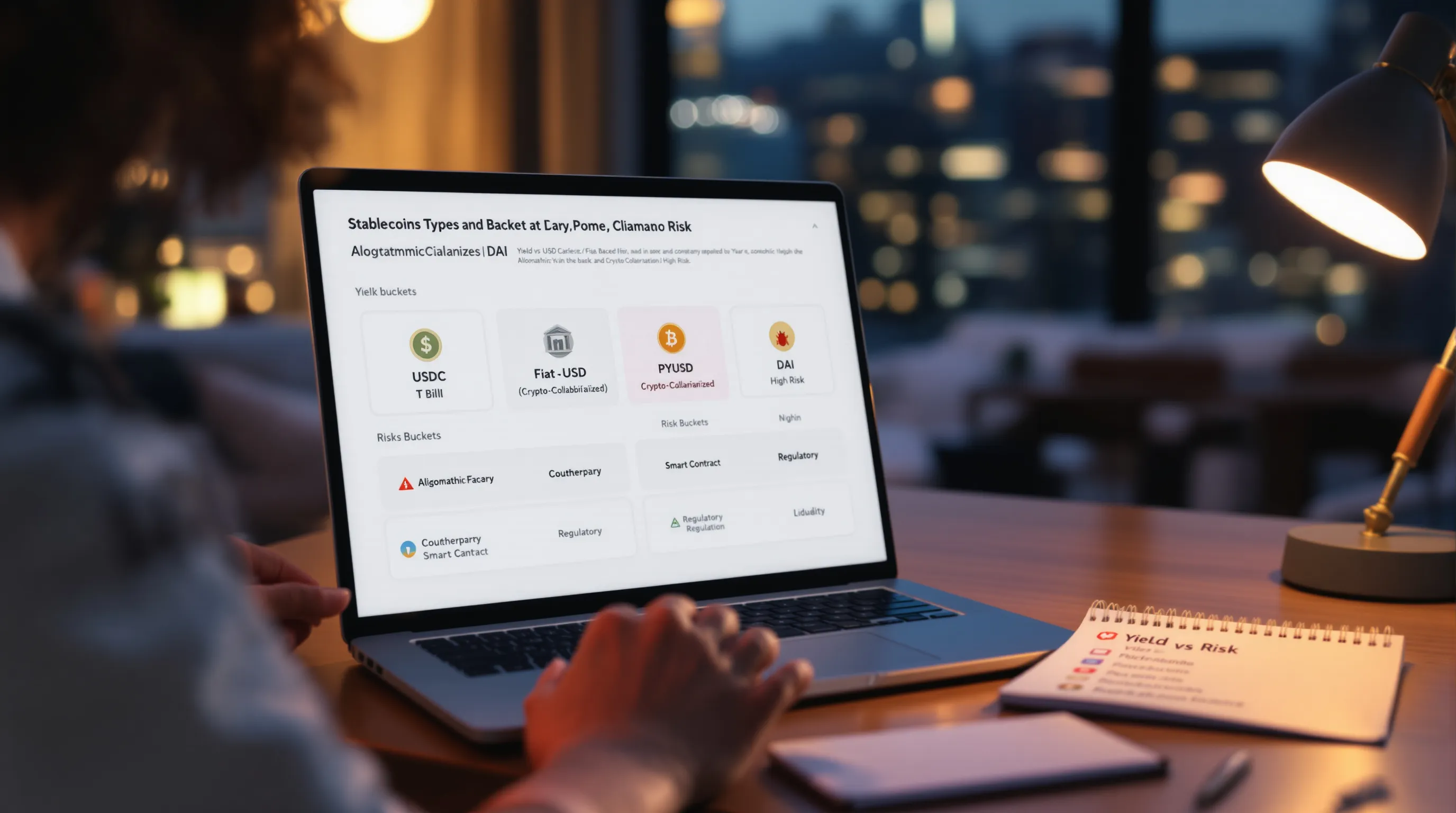
Fiat-Backed (USDC, USDP, PYUSD): Liquidity and Compliance Trade-Offs
Why it matters: Fiat-backed stablecoins are designed to hold $1 via cash and short-term Treasuries. They typically offer deep liquidity and fast off-ramps.
- Pros: Strong liquidity, institutional integrations, clearer attestations, better exchange support.
- Cons: Bank/custodian exposure, blacklist/freeze features, and policy/regulatory actions can affect redemptions.
- Notes: USDC is widely used across L2s: PYUSD and USDP emphasize compliance partnerships.
Crypto-Collateralized (DAI): Overcollateralization and Governance Risks
Why it matters: DAI is minted against crypto collateral and increasingly real-world assets. It reduces single-bank reliance but adds protocol and governance layers.
- Pros: Transparent on-chain collateral, overcollateralization, diversified backing.
- Cons: Oracle dependence, governance changes, potential exposure to RWA counterparties through the protocol.
Algorithmic and Hybrid Models: Why Caution Is Warranted
Why it matters: Purely algorithmic designs have a poor track record during stress. Hybrids that blend collateral and mechanisms can still break in tail events.
- Approach: If a coin’s peg relies on reflexive token demand, consider it high risk. Treat any yield premium as hazard pay and size accordingly.
Key Risk Buckets: Depeg, Counterparty, Smart Contract, Regulatory, and Liquidity
- Depeg risk: Stablecoin trades below $1 due to collateral issues or panic.
- Counterparty risk: Exposure to issuers, banks, custodians, brokers, or centralized venues holding your assets.
- Smart contract risk: Bugs, oracle failures, admin key misuse, upgrades gone wrong.
- Regulatory risk: Sanctions lists, enforcement actions, or KYC rules impacting access.
- Liquidity risk: Shallow pools or paused redemptions increasing slippage/outage risk.
Choose Your Yield Strategy Based on Risk/Return and Effort

CeFi Earn and Brokered T-Bill Access: Convenience vs Counterparty Risk
- What it is: Centralized platforms that pay APY on stablecoin deposits or offer T-bill exposure.
- Why it pays: They lend, stake, or buy short-term Treasuries.
- Risks: Platform solvency, rehypothecation, unclear segregation of client assets. Always read terms and audits: prefer regulated broker-dealers for T-bills.
- Fit: Hands-off users willing to accept platform counterparty risk for convenience.
DeFi Lending Markets (Aave, Compound): Variable APY From Utilization
- What it is: Supply stablecoins to pools: borrowers pay variable interest.
- Why it pays: Higher utilization drives APY: some pools offer incentive tokens.
- Risks: Smart contract/oracle risk, liquidity crunches during market stress.
- Fit: Intermediate users comfortable with self-custody and on-chain ops.
Stable-Only AMM Liquidity (Curve, Uniswap v3 Ranges): Fees and Impermanent Loss Dynamics
- What it is: Provide stablecoin-stablecoin liquidity: earn trading fees/incentives.
- Why it pays: Stable pairs minimize price variance: concentrated liquidity boosts fee capture.
- Risks: Range misplacement on v3, fees < gas, pool depeg contagion.
- Fit: Active managers who can monitor ranges and pool health.
Funding/Basis Capture With Perps: Delta-Neutral, Advanced Risk Controls Needed
- What it is: Hold stablecoins while shorting perps when funding is positive (or long basis via futures/spot).
- Why it pays: Capture funding/basis without taking direction if hedged correctly.
- Risks: Exchange counterparty risk, liquidation if hedges drift, funding flips, execution errors.
- Fit: Advanced traders with strict risk limits and monitoring.
RWA and T-Bill–Backed Tokens (sDAI, OUSG, USDM): Jurisdiction and KYC Constraints
- What it is: Tokens backed by short-term Treasuries or money market exposure.
- Why it pays: Tracks front-end yields with on-chain convenience.
- Risks: Issuer/custodian counterparty, redemption windows, accreditation/KYC/transfer restrictions.
- Fit: Users prioritizing conservative yield and compliant access.
Promotions, Boosts, and Staking Multipliers: Temporary, Read the Fine Print
- What it is: Time-limited incentives to bootstrap liquidity or TVL.
- Risks: Rewards token volatility, emission cliffs, lockups, withdrawal penalties.
- Tip: Treat boosts as a bonus, not the base case. Model returns both with and without incentives.
Prepare Your Stack: Wallets, On-Ramps, and Low-Cost Networks

KYC and On-Ramp: Compliant Exchanges and ACH/Wire Considerations (US)
- Use reputable US-facing exchanges/on-ramps with transparent fees and FDIC-insured cash accounts (for USD, not crypto).
- ACH is cheap but slower: wires settle faster with higher fees. Confirm withdrawal limits and stablecoin networks (e.g., USDC on Base, Arbitrum, Solana).
Self-Custody Setup: Hardware Wallet, Seed Hygiene, and Allowance Controls
- Hardware wallet for cold storage: store seed offline: use passphrase if supported.
- Create a separate hot wallet for daily ops: segment by chain if helpful.
- Use allowance managers to cap/spend approvals and routinely revoke unused approvals.
Choose Networks for Fees and Liquidity: Ethereum L2s (Base, Arbitrum, Optimism) and Solana
- L2s: Strong DeFi composability and blue-chip protocol support at lower gas than L1.
- Solana: Fast, low fees, growing stablecoin liquidity: different tooling.
- Pick based on your target protocol set and where the deepest pools exist for your stablecoins.
Bridging and Gas Prep: Native Bridges, MEV-Safe Swaps, and Test Sends
- Prefer native or reputable bridges: test with small amounts first.
- Maintain a gas buffer per chain (ETH on L2s: SOL on Solana). Keep a small USDC buffer for fees if supported.
- Use reputable routers/aggregators and MEV-protected modes for large swaps.
Step-by-Step: Earn Yield Using DeFi Lending Markets

Fund Your Wallet With a Supported Stablecoin (USDC/DAI) on Your Target Chain
- On-ramp USD and withdraw USDC/DAI to your self-custody address on the chosen network.
- Verify a small test transaction arrived before sending the full amount.
Evaluate Markets: APY, Utilization, Oracle Design, and Reserve Factors
- Compare supply APY and utilization. High utilization can mean higher APY but thinner withdrawal liquidity.
- Check oracle type (e.g., Chainlink) and any fail-safes.
- Review reserve factors, collateral caps, and isolation/efficiency modes.
- Scan governance/forum updates for recent parameter changes and risk disclosures.
Deposit and Start Earning: Approvals, Supply Actions, and Dashboard Checks
- Connect wallet to Aave/Compound UI.
- Approve the token spend: then Supply/Deposit.
- Confirm receipt of aTokens/cTokens. Verify APY and market health on the dashboard.
Optional: Safe Looping Practices and Setting Health Factor Alerts
- If you loop (supply stable, borrow stable, resupply), keep conservative LTV (e.g., <30–40%).
- Set alerts for Health Factor and utilization spikes. Avoid looping into correlated stablecoins.
- Understand liquidation penalties and how rapid rate changes can compress your buffer.
Monitor and Adjust: Rebalance, Pause Incentives, or Migrate If APY/Utilization Shifts
- Revisit weekly: if utilization is persistently >90% or incentives end, consider migrating.
- Use analytics dashboards to compare net APY after gas and incentives.
- When exiting, unwind loops first, repay borrows, then withdraw supplies.
Risk Management, Compliance, and Taxes (US-Focused)

Position Sizing and Diversification Across Stablecoins, Protocols, and Chains
- Diversify issuers: Split among USDC, DAI, and a conservative RWA-backed option to reduce single-issuer risk.
- Diversify venues: Spread across 2–3 protocols (e.g., a lending market + a stable AMM + RWA token) to limit protocol failure impact.
- Diversify chains: Keep positions on at least two networks to mitigate chain-specific outages or congestion.
- Sizing: Treat any strategy with leverage, re-pledging, or illiquidity as higher risk: cap to a smaller percentage of your stack.
Smart Contract Due Diligence: Audits, Timelocks, Admin Keys, and Bug Bounties
- Look for recent, reputable audits and active bug bounty programs.
- Prefer protocols with on-chain timelocks for upgrades and well-documented, limited admin powers.
- Check whether core contracts are immutable or proxy-based, and who controls the keys.
Depeg Defense: Liquidity Depth, Off-Ramp Access, and Early Warning Signals
- Favor stablecoins with deep Curve/AMM pools and active redemption mechanisms.
- Maintain access to multiple off-ramps (CEX accounts, bank wires) and a “flight” plan.
- Watch signals: peg on major DEXs, issuer announcements, reserve reports, and unusual pool imbalances.
Custody Hygiene: Revoking Allowances, Cold Storage, and Multisig Options
- Regularly revoke stale approvals via trusted tools.
- Park idle funds in cold storage: use a separate hot wallet for interactions.
- For larger treasuries, consider multisig with hardware signers and role separation.
Insurance and Backstops: Protocol Safety Modules and On-Chain Cover Providers
- Some protocols offer safety modules or backstops funded by fees/tokens.
- Third-party on-chain insurance can cover smart contract risk: read exclusions closely.
- Treat coverage as a complement, not a substitute, for diversification and sizing.
Tax Considerations: Interest, Rewards Tokens, and Cost Basis Tracking
- In the US, interest and farming rewards are typically ordinary income when received: token disposals may trigger capital gains/losses.
- Track cost basis and timestamps for every transaction. Use crypto tax software and export CSVs from wallets and exchanges.
- Not tax advice, consult a qualified professional for your situation.
Optimize, Monitor, and Troubleshoot
Aggregators and Vaults: Auto-Compounding and Gas Efficiency vs Protocol Risk
- Yield aggregators can auto-compound and route to better pools. You trade protocol simplicity for extra smart contract layers.
- Review strategy transparency, withdrawal queues, and any performance or management fees.
Performance Tracking: Benchmarks vs Treasury Yields and Stablecoin Risk-Adjusted Return
- Compare your net APY to front-end Treasury yields as a baseline.
- Adjust for risk: thicker spreads may compensate for smart contract or counterparty risk, but only if you size appropriately.
- Track volatility of rewards tokens: convert to stables periodically to realize yield.
Common Pitfalls: APY Drops, Liquidity Dry-Ups, and Rewards Token Volatility
- APYs compress as capital floods in: be ready to rotate.
- Thin liquidity can trap you during stress: test partial withdrawals.
- Incentive tokens can draw down fast, don’t count unvested rewards as cash.
Operational Issues: Stuck Transactions, Failed Bridges, and Support Escalation
- Use block explorers and RPC fallbacks for stuck txs: try replacement with higher gas if needed.
- For bridging hiccups, contact official bridge support with tx hashes: verify you used the correct chain IDs.
- Keep a runbook with links, support contacts, and your transaction records.
Recap and Next Steps
You can earn yield with stablecoins without taking wild bets by matching strategy to risk: lending markets for transparent, variable APY: stable-only AMMs for fee income: conservative RWA tokens for treasury-like returns: and advanced basis trades only if you can monitor tightly. Manage counterparty risk by splitting exposure across issuers and venues, and stay depeg-aware with multiple off-ramps ready. Start small, document your moves, and scale what works. Next steps: pick one chain, one coin, and one blue-chip protocol, run a small test for a week, then expand with data-driven iteration. Keep your benchmarks tied to Treasury yields, and let diversification and discipline do the heavy lifting.
Disclaimer: This content is for informational purposes only and does not constitute financial or investment advice.