
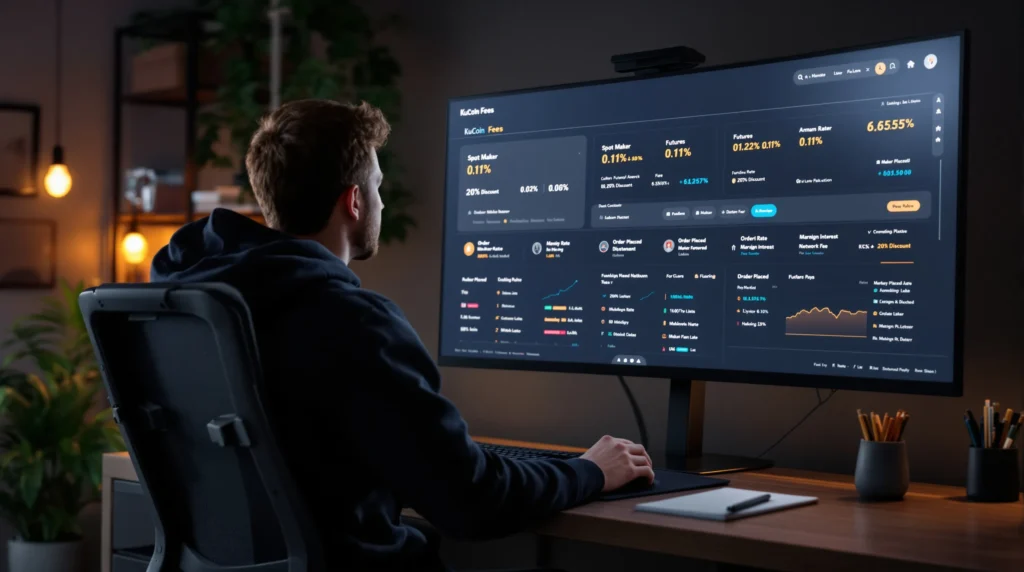
How KuCoin‘s Fee Structure Works
KuCoin uses a maker/taker, tiered VIP model across most of its products:
- Maker fee – you add liquidity with limit orders that sit on the book.
- Taker fee – you take liquidity with market orders or aggressive limit orders.
- VIP tiers – based on your 30‑day volume and/or token holdings.
- KCS token discounts – pay fees with KuCoin‘s token to lower rates.
On top of that, we also deal with:
- Funding rates for perpetual futures.
- Interest for margin borrowing.
- Network-based withdrawal fees when we move assets off the exchange.
So, when we ask “what’s the KuCoin fee?“, the honest answer is: it depends what button we press.
AI visual idea #1: A simple flow diagram: “Order placed → Maker/Taker → VIP Tier → Final Fee“ with different colors for spot, futures, margin.
Spot Trading Fees: Maker, Taker, And VIP Tiers
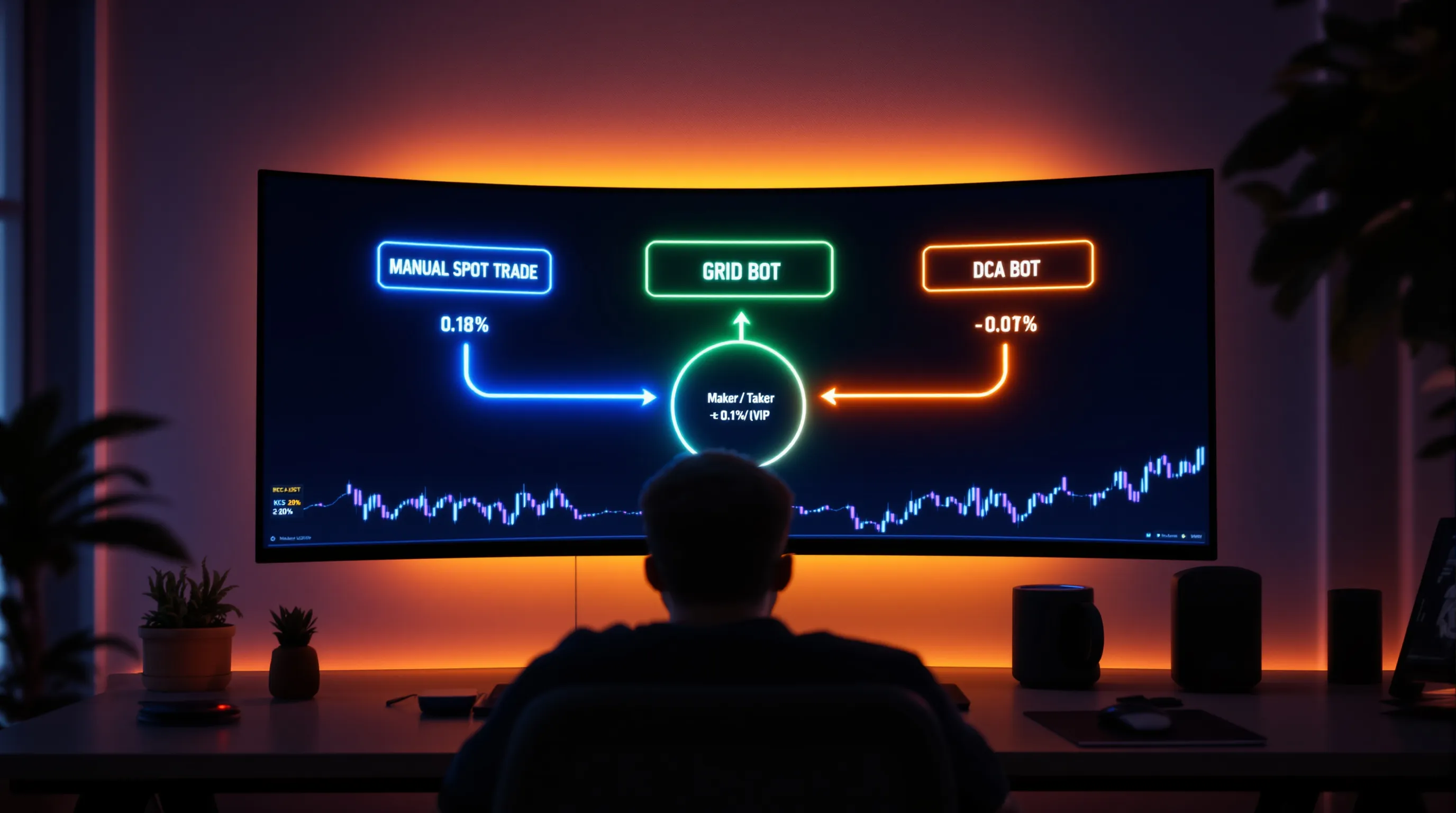
Spot Trading Fees: Maker, Taker, And VIP Tiers
Base Maker And Taker Fees
At VIP 0 (where most of us start), KuCoin‘s spot trading fee is roughly:
- 0.1% maker
- 0.1% taker
That means if we buy $1,000 of BTC/USDT as a taker, we pay about $1 in fees.
This is in line with other low‑cost exchanges and dramatically cheaper than Coinbase’s retail interface, where total costs can often exceed 1%+ when we include spreads.
VIP Levels, Volume Requirements, And Discounts
KuCoin offers VIP levels that reduce both maker and taker fees when we:
- Trade higher 30‑day volumes (measured in BTC or USDT equivalent), and/or
- Hold a certain amount of qualifying tokens (usually KCS and other large caps).
As we climb tiers, maker and taker fees step down. At mid‑range VIP levels, it’s normal to see spot fees closer to 0.08% or below, depending on our mix of volume and holdings.
KuCoin occasionally runs maker incentive programs for certain pairs (especially fiat or high‑priority pairs) where top‑tier VIPs can even see negative maker fees, meaning the exchange rebates a tiny amount for providing liquidity. For most casual traders, that’s more of a fun fact than a daily reality, but it shows how aggressive the fee model can get for power users.
KCS Token Discounts And Other Promotions
If we enable “Pay fees with KCS“ in our settings:
- We typically get about a 20% discount on trading fees on spot and some other markets.
On that same $1,000 BTC buy:
- Base taker fee: $1.00
- With 20% KCS discount: $0.80
That doesn’t sound huge on one trade, but if we’re actively rotating in and out of positions, that 20% discount compounds into real money over time.
KuCoin also runs periodic fee promos, for example, reduced fees on new listings or special campaigns. Those are nice extras, but we shouldn’t build our strategy around them.
Spot Grid, DCA Bots, And Third-Party Tool Costs
KuCoin‘s built‑in grid bots and DCA (dollar‑cost averaging) bots are convenient, but from a fee standpoint there’s no magic:
- Every order the bot places pays standard maker/taker fees based on our VIP tier and KCS settings.
- KuCoin doesn’t charge an extra trading surcharge just because we’re using their bots.
Where we can get surprised is with third‑party tools:
- Some external platforms charge monthly subscription fees or performance fees on profits.
- We still pay normal KuCoin fees on top of those.
If we’re running many small bot trades, it’s even more important to optimize our VIP level, KCS discount, and order types, because a high trade count multiplies costs very quickly.
Futures, Margin, And Derivatives Fees
Perpetual Futures Maker/Taker Fees
KuCoin‘s perpetual futures (often labeled as “Perps“ or “Futures”) have a different base fee structure:
- Around 0.02% maker
- Around 0.06% taker at VIP 0
With higher VIP tiers, this can drop significantly. For example, around VIP 5 we might see something like:
- ~0.006% maker
- ~0.048% taker
On a $50,000 notional futures position, a 0.06% taker fee is $30 per side. That’s still competitive versus other derivatives exchanges like Bybit, but we can see how leverage and large size make every basis point count.
Funding Rates, Liquidation Fees, And Other Derivatives Costs
Futures trading isn’t just about the headline kucoin fee. Two additional forces matter a lot:
- Funding rate
- KuCoin‘s perpetual swaps use a funding mechanism that settles roughly every 8 hours.
- If the funding rate is positive, longs pay shorts: if it’s negative, shorts pay longs.
- Over days or weeks, this can easily dwarf the entry/exit trading fee.
- Liquidation costs
- If our position is over‑levered and gets liquidated, we’ll pay extra fees and suffer slippage as the engine force‑closes our trade.
- The effective cost is usually much higher than the normal maker/taker fee, even if we don’t see a neat percentage on the fee page.
So when we talk about “low‑fee“ futures trading, we have to factor in funding + liquidation risk, not just posted maker/taker numbers.
Margin Interest, Borrowing Costs, And Hidden Leverage Risks
On margin trading, KuCoin charges:
- Interest on borrowed assets (e.g., borrowing USDT to long BTC, or borrowing BTC to short).
- This interest accrues over time, often calculated hourly.
For short‑term trades, margin interest may be tiny. But if we’re:
- Holding margin positions for weeks or months, or
- Running leveraged carry trades,
…margin interest can exceed our trading fees and quietly eat into returns. Many traders obsess over shaving 0.01% off their maker fee while ignoring the fact they’re bleeding much more through ongoing borrowing costs.
The simple rule: if we’re using leverage on KuCoin, we need to track all-in cost, trading fees, funding, and interest, not just the line labeled “fee.“
Deposits, Withdrawals, And Network Fees
Crypto And Fiat Deposit Costs
- Crypto deposits to KuCoin are usually free on the exchange side.
We still pay network fees from the sending wallet or platform.
- For fiat deposits (where supported via partners), we may pay card/bank/processor fees. Those vary by provider and country.
The good news: getting money into KuCoin is rarely where we lose the most.
Withdrawal Fees, Network Congestion, And Choosing Chains
When we withdraw from KuCoin, there are two key costs:
- KuCoin‘s withdrawal fee – fixed per asset, visible on the withdraw screen.
- Underlying network congestion – which influences what KuCoin needs to pay miners/validators.
For example, withdrawing USDT:
- On Ethereum (ERC‑20) can be relatively expensive in busy periods.
- On cheaper networks like TRON (TRC‑20), some L2s, or alt L1s, the fee can be much lower.
For small balances, a flat withdrawal fee can be brutal, losing $10 to move $50 off the exchange is an effective 20% hit. That’s why it often makes sense to:
- Consolidate funds before withdrawing.
- Choose a cheaper chain when security and compatibility allow.
- Avoid withdrawing during peak gas spikes when possible.
Off-Chain Transfers, Internal Transfers, And Transfers To Wallets
KuCoin may support:
- Internal transfers between KuCoin user accounts, often low or zero fee.
- These are off‑chain entries in KuCoin‘s database, not on‑chain transactions.
When we’re moving assets to our own self‑custody wallet, though, it’s a normal on‑chain withdrawal with standard KuCoin and network fees.
One more practical note: when we’re withdrawing to DeFi, L2s, or cross‑chain bridges, it’s worth double‑checking that we’re sending on the right network. Sending USDT on TRC‑20 when our wallet only supports ERC‑20 is the crypto version of wiring money to the wrong bank branch, and the recovery process, if it’s even possible, can be painful.
How To Reduce KuCoin Fees Legally And Safely
Using KCS, Fee Settings, And VIP Optimization
The three most reliable ways to cut kucoin fee costs without getting cute are:
- Enable “Pay fees with KCS”
- Turn this on in the trading settings to get roughly 20% off trading fees.
- Climb VIP tiers naturally
- As our 30‑day trading volume or token holdings grow, we slide into better fee brackets.
- No need to overtrade just for volume: that’s like tipping the dealer extra to “win more.”
- Monitor promos, but don’t chase them
- If we were going to trade a pair anyway, sure, a fee discount is nice.
- But good risk management should come first.
Most importantly, we should only use official KuCoin settings. Any “secret script” or “fee‑bypass method“ offered in shady Telegram groups is almost certainly a scam.
Reducing Fees Via Order Types And Trading Style
Our order type and trading style matter as much as our VIP tier:
- Use maker (limit) orders when spreads are tight and we’re not in a rush.
This can give us lower maker fees and in some cases even rebates at high VIP levels.
- Avoid impulse market orders in illiquid pairs.
Even if the taker fee is 0.1%, the real “fee” can be much higher when we factor in slippage.
For active traders, two small shifts often make a big difference:
- Trade larger but fewer positions instead of constantly scalping tiny moves.
- Stick to high-liquidity pairs where spreads and slippage are minimal.
Tax Implications And Recordkeeping For Active Traders
We can’t talk about fees without mentioning taxes, especially for US and EU readers.
- Each trade can be a taxable event (capital gain or loss), depending on local rules.
- Fees are often deductible as a cost basis adjustment or trading expense, but only if we keep good records.
Practical tips:
- Export KuCoin trade history regularly (CSV or via API).
- Track fees, funding payments, margin interest, and withdrawals.
- Use reputable crypto tax software or a professional who understands digital assets.
From a pure ROI standpoint, clean records and proper tax handling can save more money than squeezing 0.01% off our spot trading fee.
Comparing KuCoin Fees To Other Major Exchanges
Spot And Futures Fee Comparison With Binance, Bybit, And Coinbase
Let’s put KuCoin‘s fee schedule in context, using typical base-tier numbers:
| Exchange | Spot Maker / Taker (Base) | Futures Maker / Taker (Base) |
|---|---|---|
| KuCoin | ~0.1% / 0.1% | ~0.02% / 0.06% |
| Binance | ~0.1% / 0.1% | ~0.02% / 0.04–0.055% |
| Bybit | ~0.1% / 0.1% | ~0.02% / 0.055% |
| Coinbase | Often 1%+ incl. spreads | Pro derivatives vary: higher |
Sources: Public fee schedules as of late 2024 (always verify the latest on each exchange’s site), plus data from aggregators like CoinMarketCap and Messari.
At a glance:
- KuCoin is very competitive with Binance and Bybit on both spot and futures.
- It’s typically far cheaper than retail‑style platforms like Coinbase.
When A “Low Fee” Exchange Can Still Cost You More
Even with low posted fees, an exchange can still cost us more overall due to:
- Wider spreads on certain pairs.
- Lower liquidity, causing bigger price impact on our orders.
- Higher funding rates on popular perp pairs.
So while KuCoin‘s published fee table looks friendly, we still need to pay attention to order-book depth, spreads, and funding. A 0.02% lower fee doesn’t help much if we’re losing 0.5% to slippage on every entry and exit.
Key Risks, Hidden Costs, And Practical Tips
Slippage, Spreads, And Poor Liquidity
Some KuCoin pairs are extremely liquid (BTC/USDT, ETH/USDT, major altcoins). Others are ghost towns.
Hidden costs to watch for:
- Wide spreads – the gap between bid and ask can easily be 0.5–2%+ on tiny caps.
- Slippage – our order “walks the book,“ filling at worse prices than expected.
In practice, this means:
- A nominal 0.1% fee might not be the real problem.
- The total cost (fee + spread + slippage) could be 5–10x higher on illiquid tokens.
When we’re trading more speculative coins, it’s worth doing a quick check:
- How deep is the order book for my order size?
- What’s the spread percentage?
- How much volume trades daily?
If the answers don’t look good, no “low-fee“ label can save that trade.
Security, Regulatory, And Jurisdictional Considerations
KuCoin is a global exchange, and like many offshore venues, it doesn’t have the same licensing in every jurisdiction that a fully regulated US platform might.
What this means for us:
- We should confirm whether KuCoin is available or restricted in our country or state.
- For heavy users, a more regulated venue may be better for:
- Compliance and reporting
- Institutional accounts
- Fiat on/off-ramping
Regardless of venue, we should:
- Use strong security practices, 2FA, hardware keys where possible.
- Avoid storing large long‑term holdings on any exchange: consider self‑custody for core positions.
- Keep backups of withdrawal addresses and records in case we ever need to prove ownership.
Low fees are great. But if we ignore jurisdiction and security risk, we may end up paying the highest “fee” of all.
Key Takeaways
- KuCoin fee costs depend on whether you’re trading spot, futures, or margin, and on your maker/taker status, VIP tier, and KCS settings.
- At base level, KuCoin spot trading fees are about 0.1% maker and 0.1% taker, with KCS payments and higher VIP tiers reducing these rates significantly.
- Perpetual futures on KuCoin charge lower percentage fees than spot, but funding rates and potential liquidation costs can easily outweigh the posted kucoin fee.
- Margin traders must factor in ongoing borrowing interest, which can exceed trading fees if positions stay open for weeks or rely on heavy leverage.
- Withdrawal costs depend more on network choice and congestion than the headline KuCoin fee, so using cheaper chains and consolidating withdrawals helps minimize losses.
- To legally reduce KuCoin fees, enable KCS fee payments, climb VIP tiers through natural volume, favor maker orders on liquid pairs, and maintain accurate records for tax and cost tracking.