

We start by grounding our trading choices in observable price behavior rather than guesswork. These reference levels show where buyers or sellers have acted before, helping us mark clear entry, exit, and risk points.
Using historical highs, lows, and strong reactions we identify key levels that often trigger reversals or breakouts. We also watch round numbers, moving averages, Fibonacci zones, and trendlines to find robust clues on the chart.
Volume and candlestick patterns give confirmation so we avoid false moves. When a barrier breaks, polarity can flip it to a new floor or ceiling, creating repeatable setups we can plan around.
Because crypto markets move fast, we update our markings after big moves or high-volume sessions. That keeps our rules aligned with current liquidity and momentum and helps us trade with discipline.
Key Takeaways
- We rely on past price reactions to set objective level-based rules.
- Moving averages, Fibonacci, and trendlines add context to raw highs and lows.
- Volume and candles confirm likely reversals or breakouts.
- Polarity—broken barriers flipping roles—gives repeatable trade ideas.
- Regular updates after strong moves keep our plan current and practical.
Why support and resistance matter right now in crypto trading
Marked levels help us trade volatile markets with clarity. A support area shows where buying interest can halt a decline. A resistance zone marks where selling pressure can pause an advance.
Using historical charts, round numbers, and volume clusters helps us spot where activity concentrates. That lets us plan entries near favorable zones and avoid chasing poor moves.
We use these areas to manage risk. Placing stops just below support levels and targets under resistance levels keeps our losses controlled and profits realistic. This rules-based approach improves our decisions when markets swing fast.
- Map price movements against past reaction zones to identify potential reversals early.
- Stage partial take-profits at resistance levels to protect gains.
- Watch asset price action around round numbers for latent liquidity.
When momentum fades at a key zone, we step back. Waiting for buyers to absorb supply helps us avoid premature entries and trade with higher conviction.
Core concepts: support, resistance, and market psychology
Levels on a chart reflect how buyers and sellers have repeatedly negotiated control at specific price points. These areas act as reference marks that tell us whether buying or selling pressure has the upper hand.
What these levels tell us about buying and selling pressure
A support level serves as a floor where demand concentrates; a resistance level works like a ceiling where supply grows. Multiple re-tests and clear rejections make a level more trustworthy.
- Repeated reactions at a price point reveal crowd psychology and likely future behavior.
- Higher volume on tests strengthens the interpretation that a price area matters.
- Rounded numbers often attract orders and add a simple psychological layer we can use when planning trades.
Polarity principle: when broken levels flip roles
When a resistance breaks decisively, it often becomes new support. When a support fails, it can turn into new resistance.
Practical takeaway: Treat levels as information about behavior, not predictions. Let price action confirm our bias before we act.
Support and resistance in crypto: how to find and draw levels
We begin by scanning older price swings to find the clearest turning points on the chart. This quick left-to-right review reveals prior highs, lows, and sharp reactions that matter most to traders.
Start with historical highs, lows, and notable price reactions
Mark clear pivots first. Focus on visible swing highs, swing lows, and points where price stalled or flipped. These are the best anchors to identify support and guide our plan.
Draw clean horizontal lines and build realistic zones
We draw straight horizontal references at those pivots, then widen them into zones to reflect real market wiggle. Treat single ticks as noise; zones hold more practical value for live trading.
Switch between candlestick and line charts to filter noise
Toggle chart types to remove wick clutter and reveal the structural lows and highs traders respect across sessions. Line charts often show the pure structure; candlesticks add context for entries.
Validate levels with multiple touches and clear price rejections
Give weight to areas that saw repeated tests and decisive rejections. Round numbers or high-volume nodes that align with these zones tend to identify potential targets more reliably.
- Scan left for major pivots and notable reaction points.
- Convert lines into zones to account for volatility.
- Toggle charts, then confirm with multiple touches and rejections.
Choosing strong levels: higher time frames, pivots, and context
We anchor our maps on weekly and yearly pivots to see who truly controls price over time. This top-down view filters out intraday noise and highlights the most consequential references for trading.
Yearly and weekly pivot points reveal whether buyers or sellers have the upper hand at major decision zones. For example, Bitcoin’s reactions around a yearly central pivot in 2022 showed a clear flip from resistance to support on follow-through.
We favor recent, frequently tested areas and give extra weight to round-number clusters that attract attention from traders and investors.
- Start on weekly/monthly charts to anchor a plan before intraday timing.
- Prioritize recent tests and visible lows that align with pivots or volume nodes.
- Note how a price level behaved on prior visits—clean rejections versus grinding consolidations matter.
We fold the strongest references into our active plan and downgrade clutter so levels remain clear and actionable.
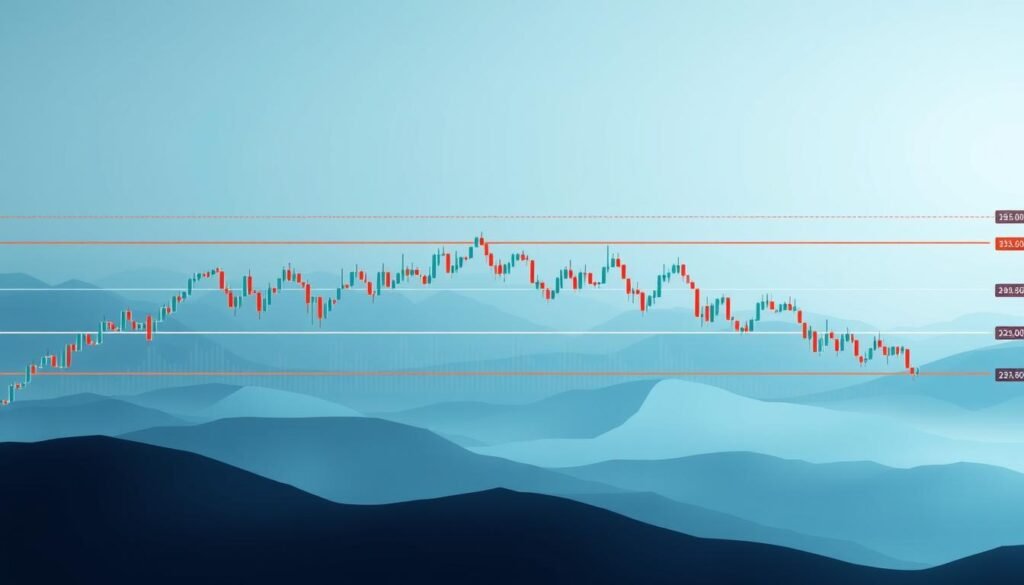
Tools and confluence: moving averages, Fibonacci, trendlines, and volume
When multiple indicators align, the chart often points to higher-probability areas. We layer a few reliable tools to turn clutter into usable signals.
Using moving averages as dynamic support and resistance
We use moving averages as adaptive guides. Short lines show momentum; longer ones show trend. When price closes above a line, that line can flip to act as support. The reverse also holds for down moves. Watching these flips helps us identify potential entries.
Applying Fibonacci retracement to map potential reversal areas
Fibonacci levels mark common pullback zones. They gain weight when they sit near prior highs or lows. We treat overlaps as higher-quality areas for planning trades.
Confluence clusters: previous highs/lows, volume profile, and trendlines
Confluence forms when MA, Fibonacci, pivot points, and volume profile meet. We require two to three factors before calling a region high quality for risk-defined setups.
“Confluence reduces guesswork—trade what multiple signals confirm.”
| Tool | Role | How we use it |
|---|---|---|
| Moving averages | Dynamic guide | Layered to validate trend, watch for flips after strong closes |
| Fibonacci | Pullback map | Align with swing points to identify likely reaction areas |
| Volume profile | Liquidity nodes | Spot high-activity bands and low-volume gaps for breakouts |
Turn levels into a trading plan: entries, exits, and risk management
We convert chart zones into precise orders and clear rules so our plan works under pressure.
We plan entries near durable support levels or after a clean break-and-retest of a prior resistance turned floor. Buying on evidence of absorption or a validated retest gives better odds than chasing raw moves.
Entry tactics and invalidation rules
- Buy near support levels after clear demand appears, or enter on a break-and-retest of a former ceiling.
- Place a stop-loss just below the structure we trade so small losses are accepted quickly when the thesis fails.
- Translate zones into exact price points for orders, allowing for spreads and volatility wicks.
Exits, targets, and confluence
Stage take-profits near resistance levels, scaling out to lock gains while leaving room for continuation. We combine indicators and volume as confluence to raise signal quality.
Execution, sizing, and review
- Adjust position size by distance to stop and setup quality for better risk-adjusted trading.
- Document invalidation rules and keep a checklist to help traders make faster decisions.
- Refresh our map after big moves so levels remain relevant to the market.
Avoid these mistakes and maintain your levels as markets evolve
Charts get messy fast; a trimmed map keeps our decisions clear. We limit marks to the clearest, most tested levels so we can act without hesitation.
Cluttered charts, too many lines, and ignoring wicks
Too many lines make analysis slow and error-prone. We draw wide zones instead of single ticks to reflect real price wiggle.
We respect wicks because those extremes show where liquidity was hit and where future reactions may occur.
Failing to update levels after major moves or volume spikes
After big volume sessions we revisit our map. Zones that lost confluence get retired, while fresh areas get documented.
- Reduce clutter: keep only the most tested levels for quick execution.
- Zone, don’t pin: avoid anchoring to single ticks; use areas that match past movements.
- Confirm with tools: use a small toolkit to validate zones during ongoing analysis.
- Schedule reviews: update maps after major moves so our trading stays aligned with the market.
When we find support resistance, or when identifying support for a trade, we use structure and volume to confirm entries. That discipline keeps traders focused and lowers emotional mistakes.
Conclusion
A clear map of price levels turns messy charts into repeatable trade plans.
We build zones from historical highs and lows, validate them with multiple touches, then use simple tools to raise confidence. This process helps us place cleaner orders and manage risk around a support level or a nearby resistance level.
Polarity matters: when a resistance breaks we look for retests as new floors. The reverse applies after a breakdown. Regular reviews keep our map aligned with recent price movements and liquidity shifts.
By keeping levels tidy and following a checklist, we help traders act calmly. For cryptocurrency and other assets, this process-first approach strengthens consistency in trading and investor decisions.
FAQ
What are the basics of navigating support and resistance in crypto?
We view these as price areas where buyers or sellers step in. They form from past highs, lows, and notable reactions. By marking those zones on a chart and watching how price behaves at them, we get signals for potential entries, exits, and stops.
Why do these levels matter right now for crypto trading?
Volatility and fast capital flows make clear price points essential. Traders use them to gauge control between buyers and sellers, set risk limits, and decide whether momentum will continue or reverse. That clarity helps us act faster and with more confidence.
What do these levels tell us about buying and selling pressure?
Areas with repeated price reactions indicate where demand or supply gained influence. When price repeatedly halts or reverses there, it shows stronger conviction from market participants. We interpret multiple tests and sharp rejections as higher probability zones.
What is the polarity principle and how does it affect our analysis?
When a level breaks, its role often flips: buyers become sellers or vice versa. A former floor can act as a cap after a break, and a former ceiling can turn into support. We treat these flips as confirmations that market sentiment shifted.
How do we find and draw reliable levels?
Start with historical highs and lows, major reaction points, and areas with long wicks. Draw clean horizontal lines or shaded zones rather than many narrow lines. Focus on clear price rejections and avoid clutter to keep charts readable.
Should we use different chart types when identifying levels?
Yes. Switching between candlestick and line charts helps filter noise. Line charts smooth minor fluctuations and highlight close-based levels, while candlesticks show wicks and intrabar behavior that matter for precision.
How do we validate a level before trading it?
Look for multiple touches, decisive rejections, and volume spikes at the area. A level tested several times without a clean break carries more weight. We also prefer confirmations like break-and-retest setups before committing capital.
Which time frames give the strongest indication of market control?
Higher time frames like weekly and monthly charts carry more influence over major moves. They show who controls longer-term sentiment. We use them to set primary zones and then refine entries on lower time frames.
What role do pivots, recency, and round numbers play in selecting levels?
Pivot points and recent reaction areas help identify where attention clusters. Round numbers attract orders and often act as magnets. We weigh levels by how recent they are, how often they were tested, and whether they coincide with psychological prices.
How can moving averages and Fibonacci tools help our analysis?
Moving averages act as dynamic barriers that price often respects, giving us adaptive zones. Fibonacci retracements map potential pullback areas after swings. When these align with historical levels, our confidence in a zone increases.
What is a confluence cluster and why is it useful?
A confluence cluster occurs when multiple tools point to the same area — previous highs, moving averages, trendlines, and high-volume nodes. We treat clusters as higher-probability zones because several sources agree on likely market behavior.
How do we turn levels into a trading plan?
Plan entries near validated zones, use break-and-retest setups, and size positions with defined stops. Place stop-loss orders beyond the zone’s edge and set profit targets before the next major area. Consistent risk rules keep our losses controlled.
Where should we place stop-loss and take-profit orders relative to levels?
Stops sit just beyond the zone to avoid being taken out by noise. Take-profit targets usually sit short of the next significant level to increase win probability. We adjust distances based on volatility and time frame.
How do we combine indicators for better signals?
Use indicators that add different information: volume for participation, momentum for strength, and averages for trend. When indicator signals align with price-level behavior, we prioritize that setup over single-tool confirmations.
What common mistakes should we avoid when marking levels?
Overcrowding charts with lines, ignoring wick behavior, and treating every minor reaction as meaningful all reduce accuracy. We keep charts clean and focus on substantial reactions supported by volume or multiple tests.
How often should we update our levels after big market moves?
Update immediately after decisive breaks or volume-driven moves. Markets evolve quickly; yesterday’s zones can lose relevance. We reassess daily for active trades and after any major news or volatility spike.
Disclaimer: This content is for informational purposes only and does not constitute financial or investment advice.